
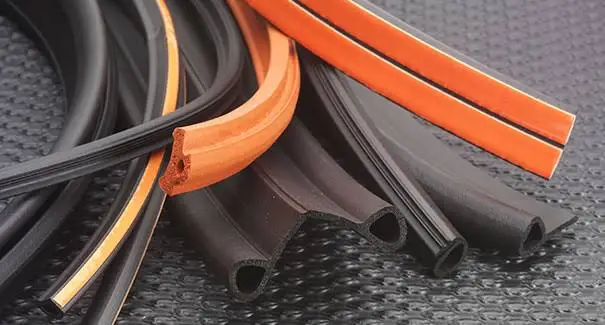
Choosing the right rubber door seal is not just about stopping a draft. The material you select determines how long the seal lasts, how well it handles sun and temperature extremes, and whether it maintains a reliable barrier against air, water, and noise year after year. With several rubber compounds available, each performing very differently in real-world conditions, getting this decision right the first time saves both money and rework.
This guide compares the three most common rubber materials used in door and window sealing: EPDM, PVC, and silicone. You will find out what each material is, where it excels, where it falls short, and how to match the right rubber seal to your door type and application.
What Is a Rubber Door Seal?
A rubber door seal is a flexible strip or profile installed around the perimeter of a door to close the gap between the door and its frame. These seals compress when the door closes, creating a barrier that blocks air infiltration, water, dust, insects, and sound from passing through the gap.
Rubber door seal strips are used on:
- Residential entry and patio doors
- Commercial storefront and office building doors
- Industrial access and warehouse doors
- Sliding, hinged, and folding door systems
- Windows and curtain wall assemblies in commercial construction
The term “rubber door seal strip” refers to the general profile shape: a long, flexible extrusion with a sealing element (bulb, wiper, fin, or gasket profile) attached to a carrier that mounts to the door frame or door face.
Not all rubber is the same. The compound used to manufacture the seal determines its resistance to UV radiation, temperature extremes, ozone, moisture, and mechanical wear, which in turn determines how long it holds its sealing performance before it needs replacement.
The Three Main Rubber Materials for Door Seals
EPDM (Ethylene Propylene Diene Monomer)
EPDM is a synthetic rubber engineered for long-term outdoor sealing performance. It is the most widely used rubber material in commercial and industrial door and window weatherstripping because of its combination of durability, weather resistance, and dimensional stability under repeated compression.
Key properties of EPDM rubber door seals:
- Outstanding resistance to UV radiation and ozone, the two primary causes of rubber degradation in outdoor applications
- Broad operating temperature range, typically from around -40 degrees Fahrenheit to above 250 degrees Fahrenheit, making it suitable for cold climates and hot sun-exposed installations alike
- Excellent water and steam resistance
- Strong compression set resistance, meaning the seal returns to its original shape after the door opens rather than permanently flattening over time
- Good resistance to mild acids and alkalis
- Service life of 10 to 20 years or more in typical exterior door applications
EPDM rubber door seals are available in an extensive range of profiles: bulb seals, T-slot gaskets, wiper seals, D-profiles, E-profiles, P-profiles, and fully custom extruded shapes designed to fit specific door systems and frame geometries.
Where EPDM excels: Exterior residential doors, commercial entry systems, storefronts, industrial doors, curtain wall systems, and any application where the seal will be exposed to sun, rain, and temperature cycling over many years. EPDM is the standard material for commercial door perimeter gasket systems and is specified in AAMA and other fenestration industry standards.
Limitations of EPDM: EPDM has poor resistance to oils, fuels, and many solvents. In environments with significant petroleum product exposure, neoprene or nitrile rubber is a better choice. EPDM also does not bond well to certain adhesives, so mechanical fastening or carrier-based installation is often preferred for commercial applications.
PVC (Polyvinyl Chloride)
PVC weatherstripping is made from polyvinyl chloride, a thermoplastic rather than a true rubber. It is widely used in residential door and window sealing because it is inexpensive, easy to process into a variety of profile shapes, and available with built-in color to match window and door frame finishes.
Key properties of PVC door seal strips:
- Lower upfront cost than rubber alternatives
- Good resistance to moisture and mild chemicals
- Available in a wide range of colors and finishes, useful for architectural matching
- Can be coextruded with softer TPE (thermoplastic elastomer) materials to add flexibility to specific sealing zones
- Moderate temperature performance in typical residential conditions
Where PVC excels: Interior doors, residential windows and sliding doors, low-traffic applications, and installations where color matching and low cost are priorities over long-term durability. PVC door seal strips are the most common type found in hardware stores and are suitable for many standard residential applications.
Limitations of PVC: PVC becomes brittle over time when exposed to UV radiation and wide temperature swings. In direct sunlight, PVC seals on exterior doors can crack, harden, and lose their flexibility within three to seven years depending on climate and sun exposure. At very low temperatures, PVC stiffens significantly and may not compress fully to maintain the seal. It also contains plasticizers that migrate out of the material over time, causing the strip to shrink and lose flexibility even in protected installations.
For exterior doors in sun-exposed or variable-climate locations, PVC is a shorter-term solution. EPDM rubber significantly outperforms PVC in longevity and outdoor weather resistance.
Silicone Rubber
Silicone rubber is an inorganic polymer with an exceptionally wide temperature range and excellent UV stability. It is used in specialty sealing applications where standard rubber compounds cannot meet the performance requirements.
Key properties of silicone rubber door seals:
- Widest operating temperature range of any common sealing material, typically from -85 degrees Fahrenheit to 400 degrees Fahrenheit or higher in some grades
- Excellent UV and ozone resistance, comparable to EPDM
- Very soft and flexible even at extreme low temperatures, which helps maintain sealing contact on doors in very cold environments
- Good electrical insulation properties
- Inert and non-reactive with most materials, making it suitable for food contact and pharmaceutical applications
- Color-stable over time; does not yellow or discolor with UV exposure
Where silicone excels: Extreme temperature environments such as industrial ovens, cold storage facilities, and outdoor installations in very cold climates. Silicone is also specified for cleanroom doors, food processing facilities, and pharmaceutical manufacturing where material compatibility and hygiene are critical. It is used in marine and architectural glazing applications where long-term flexibility and UV stability are required.
Limitations of silicone: Silicone is significantly more expensive than both EPDM and PVC. It has lower tear strength and abrasion resistance than EPDM, making it less suitable for high-traffic doors where the seal experiences repeated mechanical stress. Silicone does not bond well to many adhesives or substrates without specialized primers, so installation typically requires mechanical fastening. For standard exterior doors and commercial entry systems, EPDM delivers comparable UV and weather resistance at a lower cost.
EPDM vs PVC vs Silicone: Side-by-Side Comparison
| Property | EPDM | PVC | Silicone |
| UV resistance | Excellent | Poor to moderate | Excellent |
| Temperature range | -40 to 250+ F | -10 to 140 F | -85 to 400+ F |
| Compression set resistance | Excellent | Moderate | Good |
| Water resistance | Excellent | Excellent | Excellent |
| Oil and fuel resistance | Poor | Moderate | Poor |
| Typical lifespan (exterior) | 10 to 20+ years | 3 to 7 years | 10 to 15 years |
| Cost | Moderate | Low | High |
| Best application | Commercial and exterior doors | Residential, interior, low-cost | Extreme temp and specialty |
EPDM Door Seals: Why They Are the Industry Standard
For exterior door sealing across residential, commercial, and industrial applications, EPDM rubber is the material professionals and manufacturers specify most often. The reason comes down to the combination of properties that matter most for outdoor sealing: UV resistance, temperature stability, compression recovery, and service life.
PVC is less expensive upfront but needs replacement more frequently and performs poorly in UV-exposed or cold-climate installations. Silicone matches EPDM in UV and temperature performance but costs significantly more and offers lower mechanical durability for door applications.
EPDM door seals are available in an extensive range of extruded profiles to fit virtually any door system:
Bulb seals compress against the door face when closed, creating a reliable air and water barrier. They are used on the sides and top of hinged doors and are common on commercial entry doors.
T-slot gaskets snap into a machined or extruded channel in the door frame. They are standard in aluminum-framed commercial doors and storefront systems and provide a clean, integrated appearance.
Wiper seals use a flexible fin or lip that drags lightly across the door face as it closes, sealing against air and dust. They are common on sliding doors and windows.
D-profile and P-profile seals are self-adhesive or mechanically fastened strips used on residential and light commercial doors where a simple, compressible seal is needed along the door stop.
Perimeter gasket systems cover all four sides of a commercial door, including a bottom threshold seal, and compress simultaneously when the door closes to create a complete, tested perimeter seal. These systems are standard in commercial construction and are available in EPDM for compliance with energy codes and fenestration standards.
Rubber Weatherstripping for Doors: Residential vs Commercial Applications
The right rubber door seal strip varies depending on whether the application is residential or commercial.
Residential exterior doors typically use self-adhesive or nail-on EPDM or PVC profiles on the sides and top, with a door sweep at the bottom. For homeowners who want a longer-lasting solution than standard foam or vinyl tape, EPDM D-profiles and bulb seals are a direct upgrade that will outlast the door frame in most cases.
Commercial exterior doors require more robust solutions. Aluminum-framed storefront doors use T-slot EPDM gaskets that snap into the frame channel. High-traffic office and retail entry doors benefit from automatic door sweeps with EPDM sealing elements. Buildings subject to energy codes may require tested door and frame assemblies with certified perimeter gasket systems.
Industrial and specialty doors on warehouses, cold storage facilities, and manufacturing plants have demanding requirements: large door sizes, high-cycle operation, extreme temperatures, or chemical exposure. EPDM remains the standard for most industrial door sealing, with silicone specified where temperature requirements exceed EPDM’s range and neoprene or nitrile used where petroleum products are present.
How to Choose the Right Rubber Seal for Your Door
Work through these four questions before selecting a rubber door seal strip:
1. Is the door interior or exterior? Interior doors can use PVC or lower-grade rubber without significant performance loss. Exterior doors should use EPDM or silicone to handle UV exposure and temperature cycling.
2. What temperatures will the seal experience? If the door is in a cold climate or a heated industrial environment, check the material’s operating temperature range. EPDM handles most outdoor applications. Silicone is needed for extreme temperature environments.
3. What is the gap size and profile shape needed? Measure the gap carefully and identify whether you need a self-adhesive strip, a snap-in channel gasket, a bulb seal, or a custom profile. For standard residential doors, off-the-shelf EPDM D-profiles work well. For commercial aluminum doors, a T-slot gasket sized to the frame channel is the correct choice.
4. How long do you need it to last? If long service life is the priority, EPDM is the most cost-effective choice across most door types. If cost is the primary driver and the door is interior or low-traffic, PVC may be sufficient.
Get the Right Rubber Door Seal for Your Application
The difference between a rubber door seal that lasts two years and one that lasts twenty comes down to material selection. For exterior and commercial doors, EPDM is the compound that delivers the performance and longevity that professionals and manufacturers rely on.
Techno Rubber Industries manufactures EPDM rubber door seal strips, bulb seals, T-slot gaskets, wiper profiles, and fully custom rubber extrusions for door and window manufacturers, commercial contractors, and OEM customers across the United States. Standard profiles are available for quick-turn orders, and custom extrusion tooling is available for proprietary door system requirements. Browse our weatherstripping line or contact our team to find the right rubber seal for your door or window application.
Frequently Asked Questions
What is the best rubber seal for an exterior door? EPDM rubber is the best material for exterior door seals in most applications. It resists UV radiation, ozone, and extreme temperatures better than PVC, and it maintains its sealing performance for 10 to 20 years or more without cracking or hardening. For very high or very low temperature environments, silicone rubber may be specified instead.
What is the difference between an EPDM door seal and a PVC door seal strip? EPDM is a synthetic rubber with excellent UV resistance, broad temperature performance, and long outdoor service life. PVC is a thermoplastic that is less expensive but becomes brittle and loses flexibility with UV exposure over time. On exterior doors, EPDM outlasts PVC by a significant margin and is the material used in commercial and industrial door sealing.
What does a rubber door seal strip do? A rubber door seal strip closes the gap between the door and its frame when the door is closed. It compresses against the door or frame surface to create a barrier against air infiltration, water, dust, insects, and noise. The strip returns to its original shape when the door opens, allowing it to seal again on the next closure.
How long does a rubber door seal last? EPDM rubber door seals typically last 10 to 20 years or more on exterior doors. PVC door seal strips generally last 3 to 7 years before UV exposure causes them to crack and harden. Silicone rubber seals have a service life similar to EPDM under most outdoor conditions.
Can rubber weatherstripping be used on both doors and windows? Yes. EPDM rubber weatherstripping and gasket profiles are used extensively on both doors and windows, including residential entry doors, commercial storefronts, sliding and folding doors, aluminum curtain wall systems, and residential window frames. Many profiles are designed specifically for window glazing channels, while others are optimized for door perimeter sealing.
What is an EPDM door seal used for? EPDM door seals are used to weatherproof exterior residential and commercial doors, seal commercial aluminum storefront door systems, provide perimeter gaskets on energy-code-compliant door and frame assemblies, and deliver long-term sealing performance on industrial and specialty doors. EPDM is also used in automotive door seals, construction expansion joints, and window glazing seals across multiple industries.