
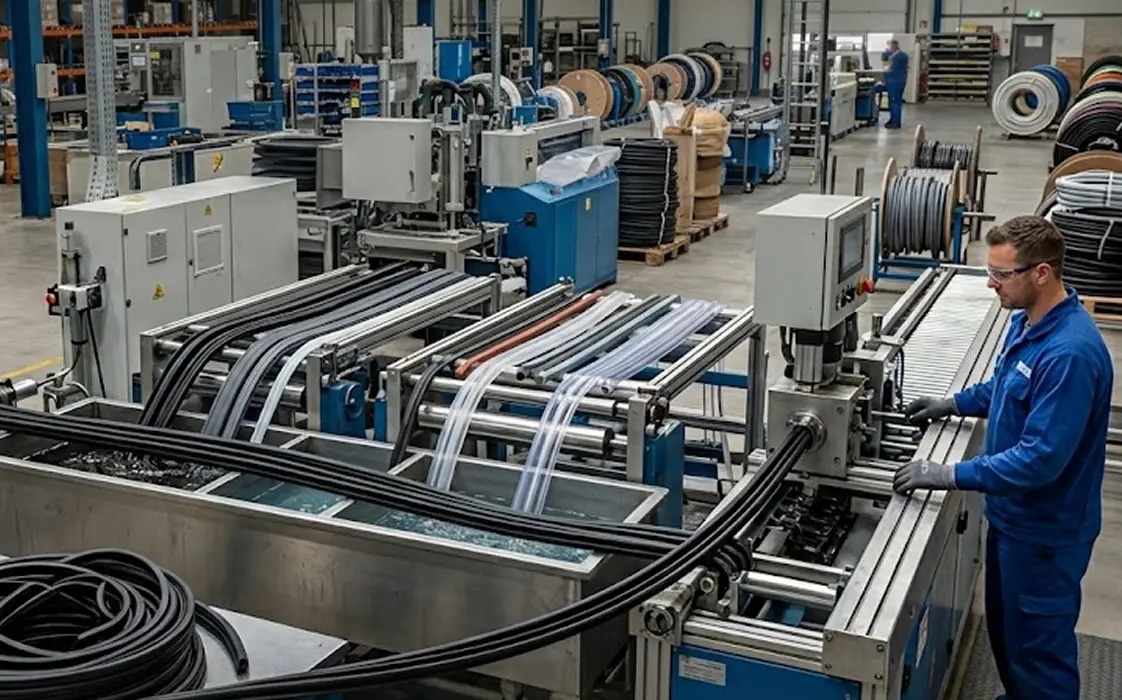
Not every sealing or profile application can be solved with the same rubber compound. When a project calls for extreme temperature performance, food-contact compliance, or long-term flexibility in demanding environments, silicone rubber extrusion is often the specification that delivers where other compounds fall short.
Understanding when silicone is the right call, and when another compound like EPDM is the better fit, is what separates a well-specified rubber profile from one that fails ahead of schedule or costs more than the application requires. This guide covers how silicone rubber extrusion works, what makes silicone distinct, where it is used, and how it compares to EPDM and other extruded rubber compounds.
What Is Silicone Rubber Extrusion?
Silicone rubber extrusion is a manufacturing process in which uncured silicone rubber compound is forced through a shaped die to produce a continuous profile with a consistent cross section. The extruded profile is then cured, typically by passing through a vulcanization oven or salt bath, to set the rubber’s final properties.
The result is a finished rubber profile: a strip, tube, cord, or custom shape that holds its cross-sectional geometry and properties consistently along its entire length. Extruded silicone profiles are used as seals, gaskets, tubing, edge trim, weatherstripping, and structural glazing profiles across a wide range of industries.
The extrusion process allows rubber profile manufacturers to produce virtually any cross-sectional shape, from simple round cords and flat strips to complex multi-cavity profiles with hollow sections, lips, fins, and integrated carrier features. Custom tooling is cut to match the design geometry, and once the die is made, the same profile can be produced repeatedly with tight dimensional consistency.
The Rubber Extrusion Process
Understanding the rubber extrusion process provides context for why material selection matters and how different compounds behave during manufacturing.
Compounding
Before extrusion begins, raw silicone polymer is compounded with curing agents, reinforcing fillers, pigments, and any specialty additives needed for the application. The compound formulation determines the finished profile’s hardness (durometer), color, temperature range, compression set resistance, and any other performance properties required by the specification.
Extrusion
The compounded rubber is fed into the rubber extrusion machine, where a rotating screw conveys the material forward under pressure and pushes it through the shaped die. The die is precision-machined to the cross-sectional shape of the finished profile, accounting for the swell that occurs as the rubber exits the die under pressure.
A rubber extrusion machine for silicone operates at relatively low temperatures compared to thermoplastic extrusion because silicone is heat-cured rather than heat-melted. The extrusion temperature is managed carefully to keep the compound workable without initiating premature cure.
Vulcanization
After exiting the die, the extruded profile passes through a vulcanization system to cure the rubber and lock in its final properties. Common vulcanization methods for silicone rubber extrusion include:
- Hot air vulcanization (HAV): The profile passes through a heated oven where hot air cures the rubber. This method is used for most silicone profiles and allows continuous production.
- Salt bath vulcanization: The profile passes through a bath of molten salt at controlled temperature. This method provides rapid, uniform cure and is used for profiles requiring tight dimensional tolerances.
- Steam autoclave: Used for some specialty silicone profiles and molded parts that require post-cure under pressure.
Post-Processing
After vulcanization, extruded silicone profiles may undergo secondary operations including cutting to length, punching, splicing into gasket frames, surface coating, or post-cure in a secondary oven to drive off residual volatiles and stabilize the compound’s properties.
Properties of Silicone Rubber Extrusions
Silicone rubber has a distinct property profile that sets it apart from other extruded rubber compounds. These properties are what drive its specification in demanding applications.
Temperature Range
Silicone’s most defining property is its exceptional temperature performance. Standard silicone rubber compounds maintain their flexibility and physical properties from approximately -85 degrees Fahrenheit to 400 degrees Fahrenheit. Specialty high-temperature silicone grades extend performance to 480 degrees Fahrenheit or higher in short-term exposure.
This range is significantly wider than EPDM (typically -40 to 250 degrees Fahrenheit) and far exceeds PVC and most thermoplastic elastomers. In applications where seals or profiles must perform in both cryogenic and high-heat conditions, or where continuous elevated temperature exposure is required, silicone is the material that delivers.
UV and Ozone Resistance
Silicone is inherently resistant to UV radiation and ozone, making it suitable for outdoor applications without the degradation that affects natural rubber and many synthetic compounds over time. Unlike PVC and some other thermoplastics, silicone does not become brittle, discolor, or crack under prolonged UV exposure.
Flexibility at Low Temperatures
Silicone remains flexible and compressible at temperatures where other rubber compounds stiffen. This property is critical for door and window seals in extremely cold climates, aerospace applications, and refrigeration equipment where maintaining a reliable seal at sub-zero temperatures is required.
Compression Set Resistance
Compression set is the permanent deformation that occurs when a rubber seal is held under compression over time. A high compression set means the seal does not fully recover its original shape when the compression is removed, which reduces sealing effectiveness. Silicone has good compression set resistance, particularly at elevated temperatures where other compounds perform poorly in this regard.
Chemical Inertness and Food Contact Compliance
Silicone is chemically inert and does not react with most substances it contacts. Food-grade silicone compounds meet FDA 21 CFR and EU food contact regulations, making silicone extrusions the standard material for seals and tubing in food processing, pharmaceutical manufacturing, and medical device applications.
Electrical Properties
Silicone has good dielectric properties and is used in electrical insulation applications. Conductive and semi-conductive silicone formulations are also available for EMI/RFI shielding applications.
Limitations
Silicone has lower tear strength and abrasion resistance than EPDM and natural rubber. In applications where the seal or profile experiences significant mechanical abrasion or is subject to repeated tearing stress, EPDM or neoprene may be the more durable choice. Silicone is also more expensive than most other extruded rubber compounds, and its poor adhesion to many substrates requires specialized bonding methods.
Common Uses of Extruded Silicone Rubber Profiles
Silicone rubber extrusion serves a broad range of industries and applications, most of which share the requirement for performance at temperature extremes, food or medical contact compliance, or long-term outdoor stability.
Industrial sealing: Silicone extrusions are used as door seals, gaskets, and perimeter seals on industrial ovens, autoclaves, furnaces, and high-temperature processing equipment where the seal must maintain a reliable barrier at temperatures that would destroy other rubber compounds.
Architectural glazing and curtain wall: Silicone profiles are used as structural glazing seals, weather seals, and setting blocks in commercial building facades. The combination of UV stability, flexibility, and long service life makes silicone the preferred material for high-performance building envelope applications.
Food and pharmaceutical processing: Food-grade silicone tubing and profile seals are standard in food processing lines, beverage equipment, pharmaceutical mixing and transfer systems, and medical devices. Silicone’s FDA compliance, chemical inertness, and cleanability meet the stringent requirements of these regulated industries.
Aerospace and defense: Silicone seals and profiles are used throughout aerospace applications, including aircraft door seals, access panel gaskets, and environmental seals on avionics enclosures, where the temperature range from ground-level heat to high-altitude cold is more demanding than most other applications.
Automotive: Silicone is used for engine compartment seals, turbocharger hoses, and underhood profiles where sustained elevated temperature exposure exceeds the limits of standard rubber compounds. It is also used for door seals on specialty vehicles and for glazing and roof seals on premium vehicles.
Electrical and electronics: Silicone tubing, sleeving, and extruded profiles serve as electrical insulation in high-temperature applications and as EMI/RFI gaskets in electronics enclosures.
Marine: Silicone profiles are used in marine glazing, portlight seals, and specialty marine door and hatch seals where UV stability and saltwater resistance are required alongside long-term flexibility.
Silicone Rubber Extrusion vs EPDM Rubber Extrusion
The most common comparison in rubber extrusion specification is silicone versus EPDM. Both materials offer good UV and weather resistance and are used in sealing applications, but they serve different performance tiers.
EPDM Rubber Extrusion
EPDM (ethylene propylene diene monomer) is the workhorse of outdoor rubber extrusion. It is the standard material for door and window weatherstripping, automotive body seals, roofing profiles, and construction gaskets. EPDM offers excellent UV, ozone, and weather resistance at a significantly lower cost than silicone, and it provides good mechanical properties including higher tear strength and abrasion resistance than silicone.
EPDM rubber extrusion covers the majority of outdoor sealing applications at a cost-effective price point. Its temperature range of -40 to 250 degrees Fahrenheit is sufficient for most building, automotive, and marine applications.
When to Specify Silicone Over EPDM
Specify silicone rubber extrusion when the application requires:
- Continuous operating temperatures above 250 degrees Fahrenheit, where EPDM approaches its thermal limit
- Flexibility at temperatures below -40 degrees Fahrenheit, where EPDM stiffens
- FDA or food-contact compliance for direct contact with food, beverages, or pharmaceuticals
- Long-term color stability in architectural applications where discoloration is not acceptable
- Medical device or pharmaceutical compliance requiring biocompatible materials
Specify EPDM rubber extrusion when the application requires:
- Outdoor weatherstripping, door seals, and window gaskets in standard climate conditions
- Higher mechanical durability and abrasion resistance than silicone provides
- Lower material cost at equivalent performance for the application’s actual temperature and environmental exposure
- Oil-free industrial environments where EPDM’s limitation in petroleum exposure is not a concern
| Property | Silicone | EPDM |
| Temperature range | -85 to 400+ F | -40 to 250 F |
| UV resistance | Excellent | Excellent |
| Ozone resistance | Excellent | Excellent |
| Tear strength | Moderate | Good |
| Abrasion resistance | Moderate | Good |
| Food contact compliance | Yes (food-grade grades) | Limited |
| Oil and fuel resistance | Poor | Poor |
| Cost | Higher | Lower |
| Best application | High temp, food/pharma, aerospace | Outdoor seals, weatherstripping, construction |
Custom Silicone Rubber Extrusion Profiles
One of the key advantages of the extrusion process is the ability to produce custom cross-sectional shapes that would be impractical or impossible to achieve through molding or other fabrication methods. Custom silicone extrusion tooling is machined to match a designer’s or engineer’s specified cross section, and once the die is qualified, it can produce the same profile consistently in commercial quantities.
Custom silicone profiles are specified for:
- Architectural glazing systems with specific glazing pocket dimensions
- Industrial door seals with unique frame geometries
- Medical device components requiring biocompatible sealing profiles
- Aerospace access panel gaskets with defined cross sections
- Food processing equipment seals designed to FDA-compliant standards
When specifying a custom silicone rubber extrusion, provide the profile cross section drawing with critical dimensions, durometer requirement, color, compliance standards (FDA, UL, NSF, etc.), and required length or coil format. A qualified rubber extrusion manufacturer will review the geometry for extrudability and advise on die design and tolerances.
Get the Right Rubber Extrusion for Your Application
Silicone rubber extrusion delivers performance that other compounds cannot match in high-temperature, food-contact, and specialty environments. For outdoor sealing, weatherstripping, and standard industrial profiles, EPDM rubber extrusion covers most applications at a lower cost. Matching the compound to the actual requirements of the application is what produces a profile that performs reliably and cost-effectively over its service life.
Techno Rubber Industries manufactures custom silicone and EPDM rubber extrusions, standard sealing profiles, and specialty rubber components for industrial, marine, construction, and OEM applications across the United States. Our in-house tooling and extrusion capabilities cover standard profiles and fully custom cross sections from prototype through production volumes. Browse our extrusion product line or contact our team to discuss the right compound and profile for your application.
Frequently Asked Questions
What is silicone rubber extrusion?
Silicone rubber extrusion is a continuous manufacturing process in which compounded silicone rubber is pushed through a shaped die to produce a profile with a consistent cross section, then vulcanized to cure the rubber’s final properties. The process produces seals, gaskets, tubing, cords, and custom profiles used across industrial, medical, food processing, aerospace, and construction applications.
What is the rubber extrusion process?
The rubber extrusion process involves feeding compounded rubber into an extrusion machine, where a rotating screw conveys the material through a shaped die under pressure. The extruded profile is then vulcanized using hot air, a salt bath, or steam to cure the rubber and lock in its physical properties. Secondary operations such as cutting, splicing, and surface treatment may follow depending on the application.
What is the difference between silicone and EPDM rubber extrusion?
Silicone rubber extrusion offers a wider temperature range, food-contact compliance, and superior flexibility at extreme low temperatures. EPDM rubber extrusion provides better mechanical durability, higher tear strength, and lower cost for outdoor weatherstripping and sealing applications in standard temperature ranges. For most building, marine, and automotive exterior sealing, EPDM is the standard specification. For high-temperature, food, pharmaceutical, or aerospace applications, silicone is specified.
What is a rubber extrusion machine?
A rubber extrusion machine is a screw-based processing system that conveys compounded rubber under pressure through a shaped die to produce a continuous extruded profile. The machine controls screw speed, temperature, and die pressure to produce consistent cross-sectional dimensions. After the die, the extruded profile passes through a vulcanization system to cure the rubber before being cut, coiled, or further processed.
When should I specify silicone rubber extrusion over other compounds?
Specify silicone when the application requires continuous operating temperatures above 250 degrees Fahrenheit, sub-zero flexibility below -40 degrees Fahrenheit, FDA or food-contact compliance, biocompatibility for medical applications, or long-term UV and color stability in architectural uses. For standard outdoor sealing and weatherstripping, EPDM is typically the more cost-effective specification.
Can silicone rubber extrusions be made in custom shapes?
Yes. Custom silicone rubber extrusion profiles are produced by machining a die to the specified cross-sectional geometry. Virtually any cross section can be extruded, including complex profiles with hollow sections, multiple lips, integrated fins, and carrier features. Custom tooling is a one-time investment that enables consistent production of the profile at commercial volumes.