
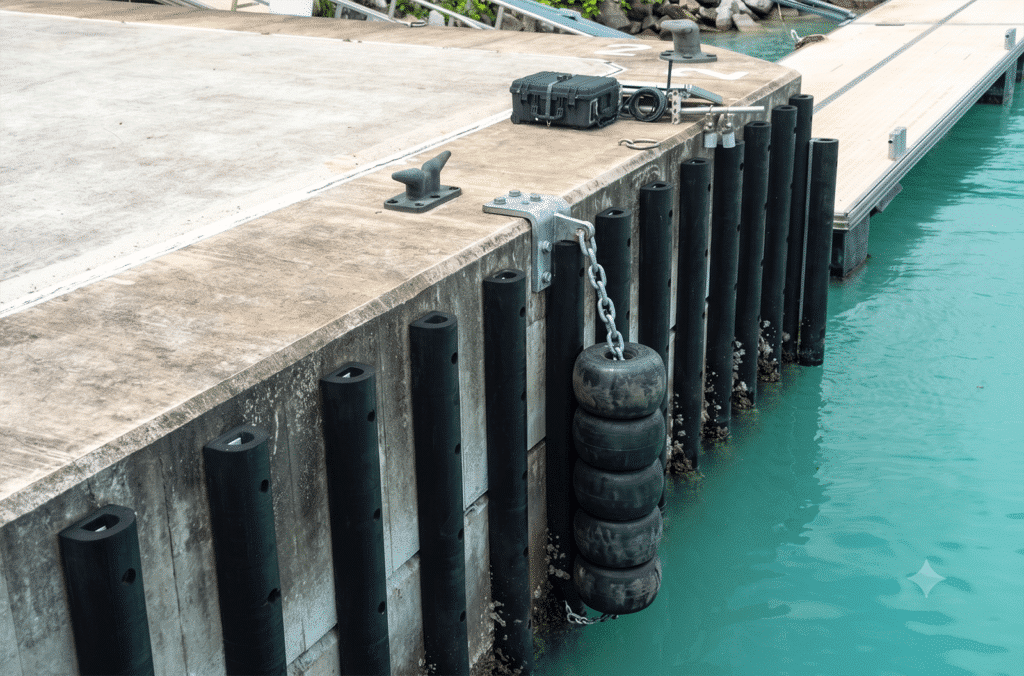
Dock pilings are easy to overlook because they are part of the structure itself. But if a boat regularly comes alongside them, even a small gap in protection can become an expensive problem over time.
The challenge is that piling damage does not always come from one hard impact. It can build gradually, especially in slips where boats shift, rub, and press against the same areas again and again. A solution that looks adequate from the dock may still leave the hull or piling more exposed than you realize.
Knowing how to protect those contact points properly can help you avoid unnecessary wear, repairs, and replacement costs. Keep reading to learn how piling bumpers and fenders differ, where each type works best, and what to consider before choosing protection for your dock.
Why Exposed Dock Pilings Can Become a Problem
Pilings provide structural support and help define slips, but their position also places them directly beside moving vessels. Unlike a flat dock face, a piling concentrates contact within a relatively narrow area.
A vessel may sit several inches away from a piling in calm conditions and then move against it when wind direction changes or another boat creates wake. Water-level changes can also alter which part of the hull lines up with the piling.
That creates two different types of contact to plan for. There is the initial bump that can happen while maneuvering into a slip, and there is the repeated rubbing or pressure that can continue after the boat is secured.
Proper piling protection needs to account for both.
What Are Dock Piling Bumpers?
Dock piling bumpers are protective profiles installed on or around pilings to create a buffer between the piling and a boat. They are intended to keep the vessel from making direct contact with hard wood, concrete, steel, or other exposed structural surfaces.
Piling protection can take several forms depending on the piling, vessel, and installation.
Piling Bumper Profiles
A piling bumper profile is mounted along the area of the piling most likely to contact the vessel. These profiles provide a projecting protective surface rather than leaving the hard piling exposed.
Techno Rubber Industries manufactures piling bumpers as part of its dock and marina product line, including high-impact PVC profiles made for marine applications. Its current piling bumper product line includes profiles manufactured in the USA for use around dock structures and waterfront installations.
Wrap-Around Piling Protection
Some piling systems use protective material around a larger portion of the piling rather than covering only one face.
This can make sense where boats approach from different angles or where the exact contact point is less predictable. The amount of coverage needed depends on how the piling sits within the slip and how vessels normally move around it.
Fender Profiles Used Along Pilings
Certain marine fender or bumper profiles can also be selected or manufactured for vertical installation.
Rubber profiles are particularly useful where cushioning, repeated contact, and outdoor weather resistance are priorities. Techno Rubber Industries manufactures EPDM rubber dock bumpers, extruded marine bumpers, fenders, and custom profiles for docks, marinas, piers, vessels, and other high-contact waterfront environments.
The terms bumper and fender are sometimes used interchangeably in dock applications. What matters more than the name is whether the profile provides the coverage, projection, material properties, and mounting configuration required at the piling.
How Piling Bumpers Protect the Boat and Dock
The purpose of piling protection is not simply to cover the piling. The profile needs to change what happens when the boat eventually makes contact with it.
Several aspects of protection matter when evaluating a bumper.
They Create Separation From the Hard Structure
A bumper projects outward from the piling so the vessel contacts the protective profile before reaching the structure underneath.
The amount of projection matters. A thin strip may cover the surface but still provide too little separation for the type of vessel using the slip.
They Cushion Repeated Contact
Marine movement does not stop after docking. A vessel can move against the same piling many times as conditions change.
A properly selected bumper or rubber fender provides a more forgiving contact surface than an exposed piling. Rubber dock profiles are specifically manufactured to cushion repeated contact and help reduce scraping, surface wear, and harsh boat-to-structure interaction.
They Protect the Piling as Well
The vessel is not the only surface exposed to wear.
Repeated boat contact can also affect coatings, finishes, and exposed areas of the piling itself. Creating a sacrificial protective surface helps keep that contact away from the underlying structure.
The bumper still needs to be inspected and replaced when worn, but replacing a protective profile can be considerably more practical than allowing repeated contact to occur directly against the dock structure.
PVC vs. Rubber Dock Piling Bumpers
Material selection should follow the conditions at the dock rather than a general assumption that one material is always better. Techno Rubber manufactures both PVC dock products and EPDM rubber marine bumpers, allowing the application to determine which direction makes sense.
Each material brings different characteristics to the installation.
High-Impact PVC
PVC is commonly used for dock bumpers, edge guards, side guards, and piling protection.
Techno Rubber Industries manufactures its Piling Bumper 3265 from high-impact PVC. The profile measures 5 inches high by 4 inches wide and is produced in a standard 10-foot length.
PVC dock profiles can be a practical option for fixed and floating dock applications where the expected level of contact suits the material. Techno Rubber also offers multiple A-, C-, D-, and P-shaped PVC dock bumper profiles, along with dedicated piling and edge protection products.
EPDM Rubber
EPDM rubber is particularly useful in demanding outdoor environments because of its resistance to UV exposure, ozone, moisture, weather, and aging.
Techno Rubber’s marine rubber bumper and fender products are manufactured for repeated impact, rubbing, and outdoor marine exposure. Its rubber product range includes dock bumpers, extruded dock bumpers, marine bumpers, Series A and Series D fenders, and custom profiles.
For a piling exposed to frequent vessel contact, a rubber profile may be worth considering when greater cushioning or a different profile geometry is required.
Neither choice should be made from material name alone. The piling dimensions, vessel, contact frequency, mounting surface, profile design, and environment all matter.
How to Choose the Right Dock Piling Bumpers
A piling bumper should be selected around what actually happens at the slip. Looking at the dock while it is empty will not always reveal where protection is needed.
Observe the vessel during docking and after it has been tied up before deciding on coverage.
Identify the Full Contact Zone
Look at where the boat touches or could touch the piling at different positions.
Do not measure only the point where the hull sits during calm water. Consider movement caused by:
- Wind
- Boat wake
- Current
- Changing water levels
- Different mooring tension
- Loading and unloading
- Different vessels using the same slip
Vertical coverage is especially important. If the boat can move higher or lower relative to the piling, a short bumper installed at one fixed height can leave another contact area exposed.
Consider Vessel Size and Use
A private slip used by one recreational boat does not necessarily need the same piling protection as a marina accommodating different vessel sizes throughout the day.
Consider the vessel’s size, hull shape, normal docking speed, and how frequently the slip is used.
Higher-traffic areas and heavier vessels can place greater demands on a bumper. That may change the appropriate material, profile size, wall thickness, or amount of protection required.
Check How Far the Bumper Projects
Coverage alone is not enough.
The profile should extend far enough from the piling to become the contact surface before another part of the piling can reach the hull. Rounded or projecting profiles can provide more separation than a thin protective layer.
The correct amount depends on the geometry of the piling and vessel, which is why dimensions should be reviewed before ordering.
Look at the Mounting Area
Round pilings, square pilings, timber posts, concrete structures, and other configurations do not offer identical mounting surfaces.
Determine how the bumper will sit against the piling and whether the proposed profile can be secured correctly without interfering with other dock components.
Existing bumper holes should not automatically determine the new profile. If the previous system failed to protect the vessel properly, copying its position may simply reproduce the same problem.
When a Custom Piling Fender Profile Makes More Sense
Standard dock piling bumpers work well when the available profile fits the structure and contact requirements. Some installations are less straightforward.
An older marina may have an unusual piling configuration. A replacement project may involve a discontinued profile. Commercial or specialty vessels may create a contact point that standard dock products do not cover properly.
In those cases, useful information for a manufacturer includes:
- A sample of the existing bumper
- Cross-section dimensions
- Piling dimensions and shape
- Required profile length
- Photos of the installation
- Mounting details
- Vessel type
- Expected contact conditions
- Preferred material or performance requirements
Techno Rubber Industries can review drawings, samples, dimensions, mounting details, and application requirements when manufacturing custom rubber fender and bumper profiles.
A custom profile should solve a specific fit or performance problem. It should not add complexity when an existing standard product already provides the required protection.
Protect the Area the Boat Will Actually Reach
Choosing dock piling bumpers starts with watching how the vessel behaves around the piling, not simply measuring the piling itself.
Find the real contact zone. Consider how that zone changes with water level and vessel movement. Then evaluate the profile, projection, material, vertical coverage, and mounting conditions needed to keep the hull away from the structure.
Techno Rubber Industries manufactures PVC piling bumpers, EPDM rubber marine bumpers and fenders, dock protection products, and custom rubber and plastic profiles in the USA. If you have piling dimensions, an existing bumper sample, a drawing, or a marine application that needs a different profile, contact Techno Rubber Industries to review the requirements and determine an appropriate solution.
Frequently Asked Questions About Dock Piling Bumpers
Piling protection depends heavily on the dock layout and vessels using it. These questions address several additional considerations that can help when planning a new installation or replacing worn bumpers.
What are dock piling bumpers used for?
Dock piling bumpers create a protective surface between a vessel and an exposed piling. They help reduce direct rubbing, scraping, and impact against the harder structure.
Do all dock pilings need bumpers?
Not necessarily. Pilings that are positioned where a vessel can contact them during docking, movement, or mooring are the primary candidates for protection. Pilings well outside any possible contact zone may not need the same treatment.
How high should piling bumpers be installed?
The protected area should correspond to the range where the vessel can contact the piling. Water-level changes, vessel loading, hull shape, and movement within the slip can all affect that range, so one fixed contact point should not be assumed.
Are rubber or PVC dock piling bumpers better?
Both can be appropriate. High-impact PVC is used for piling and dock bumper profiles, while EPDM rubber is useful where weather resistance and elastic cushioning are priorities. The better choice depends on the level of contact, profile design, installation, and environmental conditions.
Can piling bumpers be used on round pilings?
Yes, but the bumper profile and mounting approach need to suit the piling geometry. Round, square, timber, concrete, and other piling configurations may require different installation methods or profile shapes.
Can I replace an old piling bumper with a different profile?
Yes, provided the new profile fits the mounting area and provides adequate protection. Before replacing it, document the old bumper’s dimensions, shape, mounting method, and the reason it needs replacement.
How do I know when piling bumpers need replacement?
Inspect them for severe abrasion, cracking, permanent deformation, loose mounting, missing sections, or wear that allows the vessel to reach the piling. There is no single replacement schedule that applies to every installation.
Can a manufacturer reproduce an old piling bumper?
Potentially. A sample, drawing, cross-section, or accurate dimensions can help determine whether an existing profile can be matched or whether a custom extrusion is required.
Are piling bumpers only for residential boat docks?
No. Piling protection can be used at residential slips, marinas, piers, commercial waterfront facilities, floating docks, and other locations where vessels can contact structural pilings.
Do piling bumpers replace boat fenders?
Not necessarily. Dock-mounted piling protection and boat-mounted fenders solve related but different problems. A vessel may still use its own fenders even when the dock has permanent bumpers installed.