
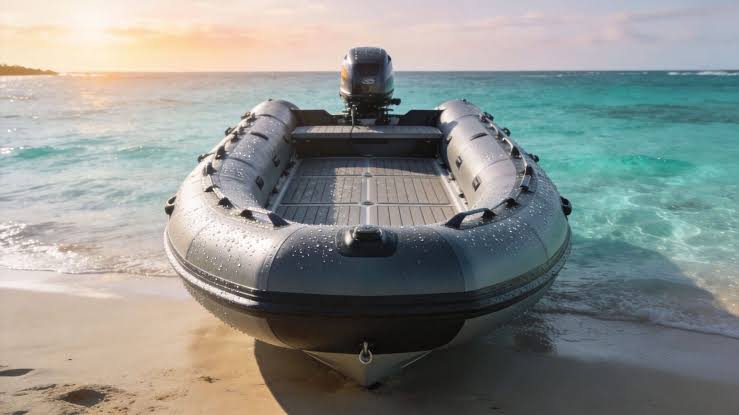
The material your inflatable boat is made from affects everything: how long it lasts, how it handles UV and saltwater, how easy it is to repair in the field, and how much it costs upfront versus over its lifetime. Whether you are shopping for a new tender, replacing an older dinghy, or trying to figure out why your current boat is delaminating, the answer usually starts with understanding what it is made of.
This guide breaks down the three main inflatable boat materials — PVC, Hypalon, and aluminum — covering what each is, how it performs in real conditions, and which applications each one suits best.
What Is Inflatable Boat Material?
Inflatable boats are built around air-filled tubes that provide buoyancy and structure. The outer skin of those tubes is the material that determines the boat’s durability, flexibility, UV resistance, and repairability. The floor and transom add rigidity and are typically made from a separate material, most commonly aluminum, fiberglass, or inflatable drop-stitch panels.
The tube fabric is a composite: a base textile (usually polyester or nylon) coated on both sides with a polymer that creates the airtight, waterproof skin. The type of polymer coating is what differentiates PVC from Hypalon and defines the boat’s performance characteristics.
Aluminum enters the picture differently. It is not a tube fabric material but a floor and hull material used in rigid inflatable boats (RIBs) and aluminum-hulled inflatables where structural rigidity, load capacity, and ease of maintenance are priorities over the lightweight portability of a fully inflatable design.
PVC Inflatable Boat Material
PVC (polyvinyl chloride) is the most widely used inflatable boat fabric in the recreational market. The vast majority of entry-level and mid-range inflatable boats, dinghies, and tenders sold today are made from PVC-coated fabric.
How PVC inflatable boats are made: A woven polyester base fabric is coated with PVC on both sides and heat-welded or glued at the seams. Modern PVC inflatables typically use high-frequency welding rather than adhesive bonding, which produces a stronger and more consistent seam.
Advantages of PVC inflatable boats:
- Lower cost than Hypalon, making PVC the accessible option for recreational buyers
- Lighter weight at comparable tube sizes, which helps with portability and car-top transport
- Available in a wide range of colors and finishes
- Easy to clean and maintain in typical recreational use
- Easier to repair with standard PVC repair kits and PVC glue for inflatable boats
Limitations of PVC inflatable boats:
- UV radiation degrades PVC over time, causing the material to become brittle, fade, and eventually crack or delaminate at the seams
- PVC performs poorly in sustained high temperatures; prolonged exposure to tropical sun accelerates degradation significantly
- Seam bonding quality varies widely by manufacturer, and lower-quality PVC boats may delaminate at the seams within a few years
- PVC becomes stiff in cold temperatures, which can make the boat harder to handle and pack in colder climates
Best for: Recreational users, occasional boaters, freshwater and protected coastal use, buyers with a lower upfront budget who plan to replace the boat within five to ten years.
Typical service life: 5 to 10 years with proper care, less in tropical or high-UV environments without UV protection treatment.
Hypalon Inflatable Boat Material
Hypalon is the trade name for CSM (chlorosulfonated polyethylene), a synthetic rubber compound developed by DuPont. It has long been the material of choice for professional, military, and heavy-duty inflatable boat applications. Note that DuPont discontinued the Hypalon brand name in 2009, though the term remains widely used in the marine industry. Current equivalents are sold under names such as CSM or Neoprene/CSM compounds by various manufacturers.
How Hypalon boats are made: Rather than being welded, Hypalon fabric is hand-glued at the seams using a two-part adhesive. This process is more labor-intensive than PVC welding, which is one reason Hypalon boats cost more. However, the adhesive bond in a properly constructed Hypalon seam is extremely durable and can be repaired in the field with the same adhesive.
Advantages of Hypalon inflatable boats:
- Outstanding UV and ozone resistance; Hypalon does not degrade from sun exposure the way PVC does, making it the preferred material for tropical and high-UV environments
- Excellent heat resistance, remaining flexible and stable in sustained high temperatures
- Good resistance to fuel, oil, and most chemicals, which matters for boats used around marinas and fuel docks
- Remains flexible in cold temperatures, maintaining handling and packability in cool climates
- Seams can be repaired in the field with the correct adhesive, and the repair bonds as strongly as the original
- Colors hold longer without fading, and the material can be painted or re-coated if needed
Limitations of Hypalon inflatable boats:
- Significantly higher cost than PVC at the same size and specification
- Heavier than PVC at comparable tube sizes
- Repairs require the correct two-part CSM adhesive and proper surface preparation; standard PVC repair kits will not bond to Hypalon
- Fewer color options and less color consistency than PVC
Best for: Professional, commercial, and military use; saltwater boating in tropical or high-UV environments; buyers who want a boat that will last 15 to 20 years or more with proper maintenance; search and rescue, dive support, and tender applications.
Typical service life: 15 to 20+ years with proper care in demanding marine environments.
Aluminum Inflatable Boats
Aluminum is not a tube fabric material but deserves a place in this comparison because aluminum-floor RIBs (rigid inflatable boats) and fully aluminum-hulled inflatable-style boats represent a distinct category that many buyers consider alongside standard inflatable designs.
Aluminum floors in inflatable boats: Most inflatable boats with a rigid floor use either plywood, fiberglass, or aluminum panels that interlock and sit inside the inflatable hull. Aluminum floors are lightweight, durable, and do not absorb water the way plywood can. They are common on quality mid-range and professional-grade inflatables.
Aluminum RIBs: A rigid inflatable boat with an aluminum hull combines the stability and load capacity of a rigid aluminum hull with the buoyancy and fendering of inflatable tubes. These boats are used extensively in commercial, rescue, and military applications where durability and load capacity outweigh the portability advantages of a fully inflatable design.
Advantages of aluminum in inflatable boat construction:
- Aluminum floors and hulls do not rot, delaminate, or absorb water
- Extremely durable and impact-resistant compared to fiberglass or plywood
- Lightweight relative to fiberglass at equivalent structural stiffness
- Low maintenance; aluminum does not need painting in most freshwater applications and is compatible with proper anodizing or marine coatings for saltwater use
- Long service life when properly maintained
Limitations of aluminum in inflatable boats:
- Aluminum hulls are rigid and cannot be folded or deflated for transport the way a fully inflatable boat can
- Aluminum is susceptible to galvanic corrosion in saltwater when in contact with dissimilar metals without proper isolation
- Repair of aluminum hulls requires welding equipment and skill, unlike inflatable tube repairs which can be done in the field
Best for: Commercial operators, rescue services, buyers who prioritize load capacity and rigidity over portability, and applications where the boat will be kept in the water or on a trailer rather than transported deflated.
PVC vs Hypalon vs Aluminum: Side-by-Side Comparison
| Property | PVC | Hypalon (CSM) | Aluminum |
| UV resistance | Moderate (degrades over time) | Excellent | Excellent |
| Heat resistance | Moderate | Excellent | Excellent |
| Cold flexibility | Stiffens in cold | Remains flexible | Rigid |
| Chemical resistance | Moderate | Good | Good (with coating) |
| Repair ease | Easy (PVC kit) | Field-repairable (CSM adhesive) | Requires welding |
| Weight | Lightest | Heavier than PVC | Varies by design |
| Cost | Lowest | Highest | Mid to high |
| Typical lifespan | 5 to 10 years | 15 to 20+ years | 20+ years |
| Best use | Recreational, freshwater | Professional, saltwater, tropical | Commercial, RIB applications |
PVC Glue for Inflatable Boats: What You Need to Know
One of the most practical questions for PVC inflatable boat owners is how to repair a damaged tube or a failing seam. PVC glue for inflatable boats is a contact cement specifically formulated to bond PVC fabric to itself or to PVC repair patches.
How to use PVC adhesive for inflatable boat repair:
- Deflate the tube completely and clean the repair area and the patch with acetone or the solvent recommended by the adhesive manufacturer. The surface must be completely clean, dry, and free of any mold release or UV protectant coating.
- Roughen both surfaces lightly with fine sandpaper to improve adhesion.
- Apply a thin, even coat of PVC adhesive to both the repair patch and the boat surface. Allow to dry until tacky (typically 5 to 15 minutes depending on temperature and humidity).
- Apply a second coat to both surfaces and allow to dry to tacky again.
- Carefully align the patch and press firmly together, working from the center outward to eliminate air bubbles. Apply firm pressure with a roller or smooth tool.
- Allow to cure for at least 24 hours before re-inflating.
Important: Standard PVC repair adhesive will not bond to Hypalon or CSM fabric. If your boat is Hypalon, you need a two-part CSM adhesive. Confirm your boat’s material before purchasing repair supplies.
Inflatable Boat Storage: How Material Affects Storage Requirements
Proper inflatable boat storage extends the life of any material, but storage requirements differ depending on the fabric.
PVC inflatable boat storage:
PVC is more sensitive to prolonged UV exposure and extreme heat than Hypalon, so storage conditions matter more. When storing a PVC inflatable:
- Store deflated in a cool, dry location away from direct sunlight
- Avoid storing in a sealed car or trailer where interior temperatures can reach extreme levels in summer sun, as heat accelerates PVC degradation and can cause seam failure
- Apply a UV protectant spray before storage if the boat will be stored outdoors under a cover
- Fold loosely rather than tightly creasing to avoid stress on the seams
- Do not store with fuel, oil, or solvents nearby, as fumes can degrade PVC over time
Hypalon inflatable boat storage:
Hypalon is more forgiving in storage because of its superior resistance to heat and UV. Standard precautions still apply:
- Store in a cool, dry location out of direct sun when possible
- Clean thoroughly before storage, as salt and marine growth can accelerate wear at seams and fittings over time
- Store partially inflated if space allows to avoid stress creases on the tube fabric
General inflatable boat storage tips for all materials:
- Rinse with fresh water after every saltwater use before storage, even short-term
- Inspect seams and valves before storing; a slow leak left unattended can cause stress on the tube fabric over time
- Store on a rack or hanging system rather than folded tightly for long-term storage
Inflatable Boat Sizes: How Material Choice Relates to Size
Inflatable boat sizes range from compact two-person tenders under eight feet to large commercial RIBs exceeding 30 feet. The material you choose often correlates with the intended size and use of the boat.
Small inflatables (under 10 feet): Most small recreational tenders, kayak-style inflatables, and portable dinghies in this size range are PVC. The light weight of PVC is an advantage at small sizes where portability and ease of car-top transport matter most.
Mid-size inflatables (10 to 15 feet): This range includes both recreational PVC boats and professional-grade Hypalon tenders used as yacht dinghies. Buyers planning to use the boat as a primary tender in saltwater or tropical conditions often choose Hypalon at this size for its longevity.
Large inflatables and RIBs (15 feet and up): At larger inflatable boat sizes, Hypalon is standard in professional and commercial applications. Aluminum RIBs also appear at this size range, particularly in rescue, patrol, and commercial passenger applications.
The relationship between material and size is practical: the longer you expect to keep the boat and the harder you plan to use it, the more the premium for Hypalon or aluminum materials pays off over the ownership period.
Protect and Maintain Your Inflatable Boat with the Right Accessories
The material your boat is made from determines its durability, but the accessories and components installed on it also contribute to how long it lasts and how well it holds up to daily use.
Techno Rubber Industries manufactures EPDM rubber inflatable boat accessories including rub rails, handles, flats, end caps, and anti-slip profiles for inflatable boats, dinghies, and tenders. Our components are made in the USA and available in standard profiles and custom extrusions for boat builders and repair professionals. Browse our inflatable boat accessories line or contact our team to find the right rubber components for your application.
Frequently Asked Questions
What is the best material for an inflatable boat?
For recreational and budget-conscious buyers, PVC is the most practical choice, offering light weight and low cost with a service life of five to ten years. For saltwater, tropical, and professional use where longevity matters more than upfront cost, Hypalon (CSM) is the better material, lasting 15 to 20 years or more with proper care.
How long does a PVC inflatable boat last?
A PVC inflatable boat typically lasts five to ten years depending on UV exposure, storage conditions, and how often it is used in saltwater. Boats stored in direct sun or kept in tropical environments without UV protection will degrade faster. Proper storage and periodic UV treatment can extend service life.
What is the difference between PVC and Hypalon inflatable boats?
PVC is a thermoplastic coating that is less expensive and lighter but degrades with UV exposure over time. Hypalon (CSM) is a synthetic rubber that resists UV, ozone, and heat far better and lasts significantly longer, but costs more and requires a specific two-part adhesive for seam repairs rather than standard PVC glue.
Can I use PVC glue to repair a Hypalon inflatable boat?
No. Standard PVC contact cement will not bond to Hypalon or CSM fabric. Hypalon repairs require a two-part CSM adhesive specifically formulated for that material. Using the wrong adhesive will result in a repair that fails quickly. Always confirm your boat’s material before purchasing repair supplies.
What size inflatable boat do I need?
Inflatable boat sizes are typically matched to the number of passengers and the intended use. A two-person recreational tender works well in the eight to ten foot range. A family boat or yacht dinghy generally falls in the ten to thirteen foot range. Larger commercial or professional applications typically use boats 15 feet and up. Always check the manufacturer’s rated capacity for the specific model.
How should I store my inflatable boat?
Store your inflatable boat deflated in a cool, dry location away from direct sunlight and heat. Rinse with fresh water after saltwater use before storage. Apply a UV protectant if the boat will be exposed to any outdoor light during storage. Avoid tight folding on the same crease lines repeatedly, and inspect seams and valves before and after storage.