
Boat fenders and dock bumpers are both meant to protect against contact, but that does not mean they solve the same problem. Choosing the wrong setup can still leave the hull, dock edge, piling, or slip exposed even when some type of protection is already in place.
The confusion usually starts because both products seem to do the same job from the outside. Once you look at how they are used, where they protect, and what happens in different docking situations, the differences become much more important.
If you are deciding what your boat, dock, marina, or slip actually needs, keep reading. We will break down how boat fenders and dock bumpers compare, where each one makes the most sense, and when relying on only one may not give you the protection you expect.
What Is a Boat Fender?
Boat fenders are movable cushions placed between the hull and another surface before or while a vessel is docking. They are normally secured to the boat with fender lines and positioned wherever contact is expected.
Traditional recreational boat fenders come in several forms, including cylindrical, round, and flat designs. They work by compressing between the boat and another surface, reducing direct hull-to-dock or boat-to-boat contact.
Their biggest advantage is flexibility.
If you visit a different marina, raft alongside another boat, use a fuel dock, or approach a dock with an unfamiliar height, the fenders can be moved to match the situation. They travel with the boat instead of depending on every dock you visit to have adequate protection.
Placement, however, matters. A boat fender that hangs too high, too low, or away from the real contact point may be pushed aside or provide very little protection.
What Is a Dock Bumper?
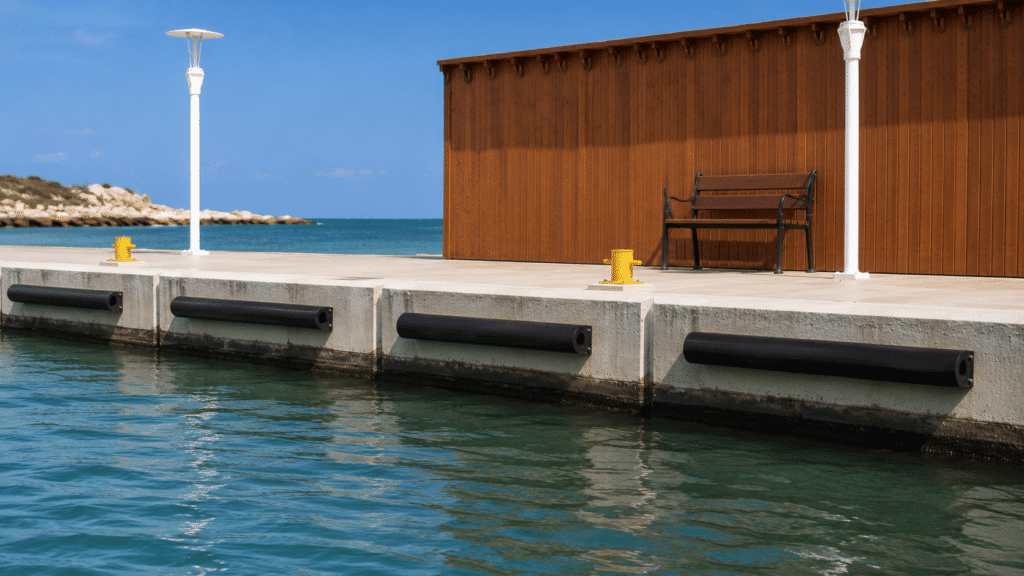
A dock bumper is attached to the dock, piling, pier, quay, or another fixed waterfront surface. Instead of moving with the vessel, it stays positioned at the area where boats are expected to make contact.
Techno Rubber Industries manufactures EPDM rubber dock bumpers and fenders, PVC dock bumpers, piling bumpers, edge guards, and custom profiles for docks, marinas, piers, vessels, and commercial waterfront facilities.
Fixed dock protection can include:
- D-shaped rubber fenders
- Flat bumper profiles
- PVC dock bumpers
- Piling bumpers
- Edge and side guards
- Corner protection
- Custom extruded marine profiles
Because the protection remains attached to the dock, it does not need to be repositioned every time a vessel enters the slip.
That makes dock bumpers particularly useful for permanent slips, marina berths, commercial docks, and other locations where boats repeatedly contact the same surfaces.
Boat Fenders vs. Dock Bumpers: The Main Differences
Both products create separation between a vessel and a harder surface, but they solve the problem from opposite sides. One belongs to the vessel. The other belongs to the dock.
Understanding those differences makes it easier to decide which type of protection should carry most of the load in your application.
Boat Fenders Move With the Boat
Boat fenders are portable.
They can be adjusted depending on dock height, vessel position, the side being used for docking, and the type of structure the boat is approaching. That makes them useful for boats that regularly visit different docks.
They can also provide protection during rafting, where two boats are tied alongside each other and no dock-mounted bumper is available between them. Round and cylindrical fenders are commonly used for these types of temporary contact situations.
The tradeoff is that someone has to position them correctly.
If a fender shifts, rides upward, drops below the contact area, or gets pushed between pilings, the hull may still reach the structure.
Dock Bumpers Stay at the Contact Point
Dock bumpers provide fixed protection.
Once the correct profile has been installed in the correct place, the protective surface remains there each time a vessel comes alongside.
That is valuable at a permanent slip because the boat often contacts the same dock face, piling, corner, or edge repeatedly.
A fixed rubber or PVC profile also makes it possible to protect longer sections rather than relying only on isolated hanging fenders.
The limitation is equally clear: the dock bumper only protects the areas where it is installed. A bumper mounted along one dock face will not protect an exposed piling several feet away.
Boat Fenders Protect the Vessel Wherever It Goes
If the boat moves to another dock, its fenders go with it.
This makes boat-mounted protection especially important for cruising, transient slips, fuel stops, launches, and other situations where the condition of the next dock is unknown.
Even a boat kept in a well-protected permanent slip may still need portable fenders whenever it leaves that slip.
Dock Bumpers Protect the Structure Too
A dock bumper is positioned between the vessel and the dock itself.
That means it can reduce direct contact not only with the boat but also with vulnerable dock edges, pilings, pier faces, and other structural surfaces.
Techno Rubber’s dock and marina profiles are intended for areas exposed to repeated rubbing, movement, impact, water, sun, and weather.
For marina operators or dock owners, that makes the protection of the fixed structure part of the decision rather than focusing only on the hull.
Which Do You Need for a Permanent Boat Slip?
A permanent slip is one of the situations where boat fenders and dock bumpers can work together rather than compete.
The dock bumper provides consistent protection at known contact points. Boat fenders provide a second movable layer that can be adjusted as conditions or vessel position change.
Several factors should guide the setup.
Look at Where the Boat Actually Makes Contact
Watch the boat after it has been tied up, not only while it is approaching.
Wind, current, wake, water-level changes, and line tension can move the vessel toward different areas throughout the day.
Check:
- The main dock face
- Corners
- Pilings
- Finger piers
- Dock edges
- Areas near the bow and stern
- Places where the hull moves as conditions change
Those observations can reveal where fixed dock bumpers make sense and where movable boat fenders are still useful.
Consider Whether Different Boats Use the Dock
A private slip used by one boat has relatively predictable contact points.
A marina, fuel dock, service dock, or commercial waterfront facility may receive vessels with different hull shapes, lengths, and freeboard heights. A single narrow strip of dock protection may not line up with every vessel.
In these environments, broader fixed protection can reduce exposed areas, while visiting vessels should still use their own correctly positioned fenders.
Pay Attention to Pilings
Pilings are a special case because hanging cylindrical fenders can sometimes be pushed away from the actual contact point as the vessel moves.
West Marine recommends additional measures such as fender boards when using boat-mounted fenders against piling docks because the piling can push individual fenders aside as the boat surges.
Permanent piling bumpers offer another way to protect the structural contact area itself. Techno Rubber Industries manufactures dedicated piling bumpers as part of its dock and marina product range.
When Dock Bumpers Make More Sense Than Relying on Boat Fenders Alone
Portable fenders are useful, but there are situations where permanently protecting the dock is the more practical approach.
Fixed dock bumpers become particularly valuable when the same contact areas are used repeatedly.
Examples include:
- Permanent residential slips
- Marina slips
- Fuel docks
- Piers and quays
- Commercial docking areas
- Exposed pilings
- Floating docks
- Workboat facilities
- Areas with repeated vessel traffic
Instead of depending on every operator to position a fender perfectly each time, the dock already has protection installed at its most vulnerable points.
The correct profile still matters. A dock bumper that is too small, positioned incorrectly, or poorly suited to the expected contact may not provide enough separation between the hull and structure.
When Boat Fenders Are Still Essential
Installing dock bumpers does not make portable boat fenders unnecessary.
The moment a vessel leaves its permanent slip, it may encounter a completely different dock configuration. The next dock could be higher, lower, built around pilings, poorly protected, or occupied by another vessel.
Boat fenders give the operator the ability to adapt.
They are especially useful for:
- Transient marina stays
- Fuel stops
- Rafting alongside another boat
- Unfamiliar docks
- Launch and retrieval
- Temporary tie-ups
- Situations where contact points change
For most boat owners, that means the real question is not always boat fenders or dock bumpers. It is which system should provide the primary protection at a specific location and where additional protection is needed.
How to Choose Dock Bumpers for Fixed Protection
Once you decide the dock itself needs protection, focus on the contact conditions rather than choosing a profile based on appearance alone.
Techno Rubber Industries manufactures both EPDM rubber and PVC marine profiles, and the right option depends on how the dock is used.
Match the Profile to the Surface
Straight dock faces, corners, pilings, and exposed edges do not require identical bumper shapes.
A D-shaped rubber profile may work well along a straight dock face, while a dedicated piling bumper is better suited to a vertical post. Some docks require several profiles to protect different contact areas.
Match the Material to the Environment
EPDM rubber is commonly used for permanent outdoor marine applications because of its resistance to UV, ozone, moisture, and weather exposure. Techno Rubber uses EPDM across its rubber marine bumper and fender line.
PVC profiles are also available for dock bumpers, piling protection, and other marine applications where the expected contact and installation conditions suit the material.
Account for the Amount of Contact
A lightly used residential slip and a commercial dock do not place the same demands on protective profiles.
Consider vessel size, frequency of docking, typical impact, rubbing, mounting area, and the amount of projection needed to keep the hull away from the structure.
If an existing profile needs to be replaced, its sample, dimensions, drawing, or cross-section can also help identify an appropriate replacement.
The Best Protection May Include Both
The difference between boat fenders vs. dock bumpers comes down to where the protection lives.
Boat fenders stay with the vessel, giving you adjustable protection wherever you dock. Dock bumpers remain attached to the dock, providing consistent coverage at the areas where vessels repeatedly make contact.
For a permanent slip, marina, pier, or commercial waterfront facility, relying on only one may leave avoidable gaps. Fixed bumpers can protect the dock’s predictable contact areas, while boat fenders remain available for changing conditions and unfamiliar docking situations.
Techno Rubber Industries manufactures EPDM rubber dock bumpers and fenders, PVC dock bumpers, piling protection, marine profiles, and custom rubber and plastic extrusions in the USA. If you need to replace an existing dock profile or determine what type of fixed protection fits a specific contact area, send the team your measurements, sample, drawing, or application requirements for review.
Frequently Asked Questions About Boat Fenders vs. Dock Bumpers
Questions about fenders and bumpers often come down to placement and how the boat is used. These answers address a few practical considerations that are easy to overlook.
Are boat fenders and dock bumpers the same thing?
No. Boat fenders are generally portable cushions attached to the vessel and repositioned as needed. Dock bumpers are fixed profiles or cushions installed directly on a dock, piling, pier, or other structure.
Do I need boat fenders if my dock already has bumpers?
It is still a good idea to carry boat fenders. Fixed dock bumpers only protect the dock where they are installed, while portable fenders can be used at other marinas, fuel docks, raft-ups, and unfamiliar tie-up locations.
Can dock bumpers replace boat fenders in a permanent slip?
They can provide much of the day-to-day fixed protection in a well-designed permanent slip, but movable fenders can still provide additional protection as vessel position and conditions change.
Where should boat fenders be positioned?
Position them where the hull is most likely to contact the dock or another vessel. Their height and horizontal position may need to change depending on dock height, hull shape, and the docking situation.
Are dock bumpers permanently installed?
Most dock bumper profiles are designed to remain attached to the dock or structure. They can be installed along dock faces, edges, corners, pilings, and other predictable contact zones.
Which is better for dock pilings?
Permanent piling bumpers can protect the piling itself and create a fixed contact surface. Boat-mounted fenders may also be used, but conventional cylindrical fenders can shift around pilings, so the docking configuration should be evaluated carefully.
What material is best for dock bumpers?
There is no universal best material. EPDM rubber is useful for demanding outdoor applications because of its resistance to UV, ozone, moisture, and weather. PVC is another option for suitable dock and piling applications. Profile design and expected contact matter along with material.
Can dock bumpers be customized?
Yes. Techno Rubber Industries can manufacture custom rubber or PVC marine profiles based on dimensions, drawings, samples, mounting requirements, and application details.
What should I check when replacing an old dock bumper?
Look at the existing profile shape, dimensions, mounting area, material, condition, and where the vessel actually contacts it. Keeping a sample or creating an accurate cross-section drawing can make replacement matching easier.
Are dock bumpers only for residential docks?
No. Fixed marine bumpers and fenders are also used at marinas, piers, quays, commercial waterfront facilities, workboat areas, and other locations exposed to repeated vessel contact.