
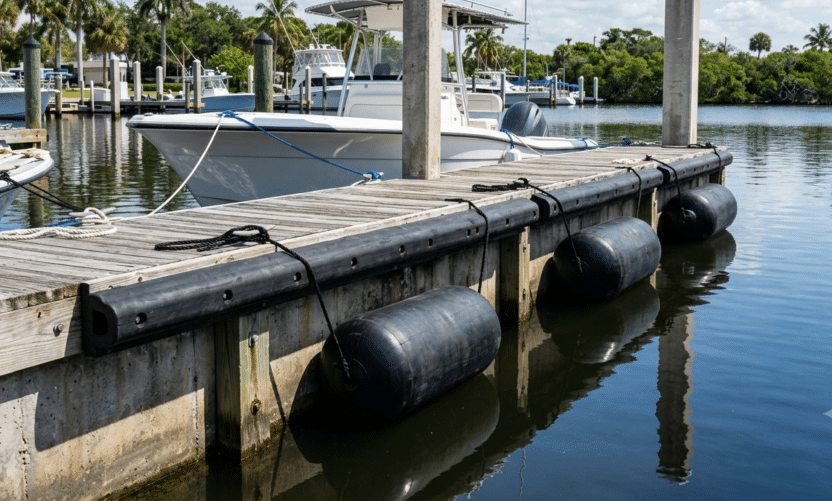
Every time a boat contacts a dock, something absorbs the impact. If that something is a properly installed dock fender bumper, the boat and dock come away undamaged. If it is bare wood, concrete, or steel, the result is scratched gelcoat, cracked hulls, and accelerating wear on both the vessel and the dock structure.
Choosing the right dock fender bumper is not complicated, but it does require matching the right profile type, size, and material to your dock layout, the boats using it, and the conditions it will face. This guide covers the main types of dock fender bumpers, how to size them, and what to look for when selecting a fender system for a residential dock, marina, or commercial waterfront facility.
What Is a Dock Fender Bumper?
A dock fender bumper is a protective strip, profile, or pad mounted on the face of a dock, pier, or bulkhead to absorb the impact and friction of boats coming alongside. The bumper sits between the hard dock structure and the boat hull, cushioning contact and preventing damage to both surfaces.
Dock fender bumpers serve several functions:
- Absorbing kinetic energy when a boat approaches or is pushed against the dock by wind and current
- Reducing friction damage on hull sides, gelcoat, and painted surfaces
- Protecting the dock structure itself from impact damage and accelerated wear
- Providing a consistent bearing surface that keeps boats a controlled distance from dock pilings and decking
Dock fender bumpers are distinct from boat-mounted fenders (the inflatable or foam cylinders hung from a boat’s rail). Dock-mounted bumpers are fixed to the dock structure and provide continuous protection without needing to be repositioned for each vessel.
Types of Dock Fender Bumpers
Dock D Fenders
The dock D fender is the most widely used profile in marine dock protection. Named for its cross-sectional shape, the D fender has a flat mounting face that attaches to the dock surface and a rounded outer face that contacts the hull.
The flat back provides full surface contact with the dock face for secure mounting, while the rounded face absorbs impact by compressing slightly and distributing load across the contact area. D fenders are typically hollow, which increases their energy absorption and reduces weight compared to a solid profile of the same size.
Dock D fenders are available in a wide range of sizes, from small profiles under two inches in height for light residential docks to large commercial profiles used on commercial piers and ship berths. They are mounted continuously along the dock face, end to end, or in sections at the key contact zones.
Best for: Straight dock faces, finger piers, residential docks, marina slips, and any dock where a boat comes alongside and rests against a flat surface.
Corner Dock Bumper Fenders
Corner dock bumper fenders are designed specifically for the outside corners of dock structures, where a dock turns, where two dock sections meet at an angle, or where a piling or post creates an exposed corner that poses a direct impact risk to passing hulls.
Unprotected corners are among the most common sources of hull damage at marinas. Even a slow, controlled approach can result in a significant impact force concentrated at a single corner point. A corner dock bumper fender absorbs and redirects that force across a larger contact area, protecting both the hull and the corner of the dock structure.
Corner fenders are typically molded or extruded to fit 90-degree angles, though custom profiles are available for other corner configurations. They are often combined with straight D fenders or flat dock bumper strips to create a complete perimeter protection system.
Best for: Outside corners on dock structures, T-head docks, floating dock corners, and any exposed structural corner that contacts boat hulls.
Flat Dock Bumper Strips
Flat dock bumper strips are solid or hollow rectangular rubber profiles mounted flush against the dock face. Unlike the D fender’s rounded outer face, flat strips provide a broad, flat bearing surface that contacts the hull across a wider area.
Flat bumper strips are commonly used on dock faces where boats tie up broadside for extended periods, such as alongside docks and commercial loading docks. They provide a stable resting surface that prevents the hull from rocking against the dock structure and reduces the risk of gelcoat wear from repeated minor contact.
Best for: Alongside tie-up positions, commercial docks with larger vessels, fuel docks, and loading facilities where sustained hull-to-dock contact is expected.
Piling Bumpers and Wrap-Around Fenders
Piling bumpers protect individual dock pilings, which are common contact points for boat hulls and topsides as vessels maneuver in and around slips. These profiles wrap around cylindrical or square pilings and are held in place by their own compression, straps, or through-bolts.
Common piling bumper profiles include:
- Wrap-around rubber strips that encircle the piling at the waterline and above
- Split profiles that can be installed on existing pilings without threading from the top
- Full piling caps that protect the top of the piling and the portion most likely to contact a boat’s rail or hull
Best for: Marina slips with exposed pilings, residential boat lifts, older docks where pilings are the primary structural element that contacts boat hulls.
Dock Edge and Rub Rail Profiles
Dock edge profiles are extruded rubber strips installed along the top edge of a dock or floating dock platform to protect the dock edge from boat contact and to protect the deck surface from impact by lines, equipment, and foot traffic. They also serve as a rub rail that keeps lines from chafing on the raw dock edge.
These profiles are often T-shaped or L-shaped to cap the dock edge and provide protection on both the vertical face and the horizontal top surface simultaneously.
Best for: Floating docks, aluminum dock systems, residential dock edges, and any dock where the top edge contacts boat rails, anchor rollers, or boarding equipment.
Dock Fender Systems: Comprehensive Dock Protection
A dock fender system is a coordinated set of bumper profiles, mounting hardware, and corner pieces designed to provide complete perimeter protection for a dock structure. Rather than installing individual sections of D fender alone, a full dock fender system addresses every contact zone: straight faces, corners, pilings, and edges.
Dock fender systems are the preferred approach for:
- New dock construction, where a complete protection solution can be planned and installed as part of the build
- Marina renovation projects where aging or damaged bumpers are being replaced across multiple slips
- Commercial facilities where consistent protection and professional appearance across the entire dock face matter
- High-traffic docks with a variety of vessel sizes that need protection across all areas of contact
A well-designed dock fender system uses compatible profiles throughout: D fenders along the straight faces, corner fenders at the turns, piling bumpers on the exposed pilings, and edge profiles along the dock top. Consistent material and durometer (hardness) across the system ensures uniform energy absorption and appearance.
Techno Rubber Industries manufactures dock fender bumpers, D fenders, piling wraps, rub rails, and custom rubber extrusion profiles for dock builders, marina operators, and marine contractors. Standard profiles are available for quick-turn orders, and custom tooling is available for proprietary dock system designs.
Dock Fender Bumper Materials
The material your dock fender bumper is made from determines how long it lasts in a marine environment and how well it absorbs impact.
EPDM Rubber
EPDM (ethylene propylene diene monomer) is the most widely used rubber material for dock fender bumpers in outdoor marine applications. It resists UV radiation, ozone, saltwater, and the wide temperature swings common in coastal and freshwater dock environments. EPDM fenders maintain their flexibility and energy absorption over long service lives, typically 10 to 20 years or more in outdoor marine use.
EPDM is the preferred material for permanent dock installations, commercial marinas, and any application where the bumper will be exposed to direct sun, saltwater, and year-round weather.
PVC and Thermoplastic Profiles
PVC dock edge profiles and bumper strips are commonly used on residential aluminum and floating dock systems. They are lower in cost than EPDM rubber and provide adequate protection for light-duty residential use. However, PVC stiffens in cold temperatures and degrades with prolonged UV exposure, limiting its service life in exposed outdoor installations compared to EPDM.
Recycled Rubber and Composite Materials
Some commercial dock bumper systems use recycled rubber or rubber-composite materials. These products vary significantly in quality and durometer, and performance depends heavily on the source material and manufacturing process. For critical applications, purpose-formulated EPDM rubber remains the most reliable choice.
How to Size Dock Fender Bumpers
Selecting the correct size dock D fender or bumper profile involves three measurements:
1. Profile height (face dimension) The height of the D fender face, measured from the flat back to the outermost point of the rounded face, determines how far the bumper projects from the dock surface and how much clearance it creates between the hull and the dock structure. Common residential D fender heights range from 1.5 to 4 inches. Commercial and marina applications often use profiles from 4 to 8 inches or larger.
A general rule: the profile height should be large enough to prevent the hull, rubrail, or any protruding fitting from contacting the dock structure behind the fender under normal wave and tide conditions.
2. Profile width (base dimension) The base width of the D fender determines its footprint on the dock face and affects lateral stability. Wider bases provide more stable mounting and better resistance to being pushed sideways under load. For floating docks with movement in multiple directions, a wider-base profile is preferred.
3. Length and coverage D fenders and flat bumper strips are typically sold in standard lengths (commonly 6, 8, or 10 feet) and cut to fit on site, or in continuous coils for custom cutting. Calculate the total linear footage of dock face that needs coverage and add 10 percent for cuts and transitions.
For corner fenders, measure the corner radius or angle and confirm the profile is designed for that geometry. Standard corner fenders fit 90-degree outside corners; custom profiles are needed for other angles.
How to Choose the Right Dock Fender Bumper
Work through these four questions before selecting a dock fender bumper:
1. What types of boats will use the dock? Larger and heavier vessels generate more impact energy and need larger, higher-durometer fender profiles to absorb that energy without bottoming out. A residential dock used by a single 20-foot runabout has very different requirements from a marina slip accommodating vessels up to 40 feet.
2. What is the dock geometry? Identify all the straight faces, corners, and exposed pilings. A straight finger pier needs only D fenders. A T-head dock with corners needs corner fenders at the turns. A slip with multiple pilings needs piling bumpers in addition to face fenders.
3. What are the environmental conditions? Saltwater installations, tropical climates, and year-round outdoor exposure favor EPDM rubber over PVC for its superior UV and weather resistance. Freshwater and seasonal-use residential docks may be well-served by either material.
4. Is this a new installation or a replacement? For new construction, specify a complete dock fender system with compatible profiles throughout. For replacement, confirm the mounting hole spacing and profile dimensions of the existing bumpers before ordering to ensure compatibility with existing hardware.
Get the Right Dock Fender Bumper for Your Application
Whether you are equipping a single residential dock slip or sourcing bumper profiles for a marina renovation, selecting the right dock fender bumper starts with matching the profile type, size, and material to the boats, dock geometry, and environment involved.
Techno Rubber Industries manufactures EPDM dock D fenders, corner dock bumper fenders, piling wraps, rub rail profiles, and custom rubber extrusions for dock builders, marina operators, and boat lift manufacturers across the United States. Browse our marine fender line or contact our team to find the right bumper profile for your dock application.
Frequently Asked Questions
What is a dock fender bumper?
A dock fender bumper is a rubber or polymer profile mounted on the face of a dock, pier, or bulkhead to protect both the dock structure and boat hulls from impact and friction damage when a vessel comes alongside. Dock fender bumpers are permanently fixed to the dock, unlike boat-mounted fenders that are repositioned for each use.
What is a dock D fender?
A dock D fender is the most common type of dock fender bumper. It is named for its D-shaped cross section, with a flat back that mounts flush against the dock face and a rounded outer surface that contacts the hull. D fenders are typically hollow, which increases their energy absorption, and are available in a range of sizes for residential and commercial dock applications.
What are corner dock bumper fenders used for?
Corner dock bumper fenders protect the outside corners of dock structures, where two dock faces meet or where a dock turn creates an exposed corner that is a direct impact hazard for boat hulls. They are used alongside straight D fenders as part of a complete dock fender system to ensure there are no unprotected impact zones on the dock structure.
What is the best material for dock fender bumpers?
EPDM rubber is the best material for outdoor dock fender bumpers in most marine applications. It resists UV radiation, ozone, saltwater, and temperature cycling, and maintains its flexibility and energy absorption for 10 to 20 years or more. PVC profiles are suitable for light-duty residential use but degrade faster under UV exposure and cold temperatures.
How do I choose the right size dock D fender?
Select a D fender profile height large enough to keep the boat hull and any protruding fittings clear of the dock structure under normal wave action and tidal movement. Larger and heavier vessels need larger-profile fenders. Measure the total linear footage of dock face to be covered and add material for cuts and corner transitions.
What is a dock fender system?
A dock fender system is a complete, coordinated set of bumper profiles covering all contact zones on a dock structure, including straight faces, corners, pilings, and edges. Full dock fender systems are used on new dock construction, marina renovations, and commercial facilities where consistent protection and appearance across the entire dock are required.