
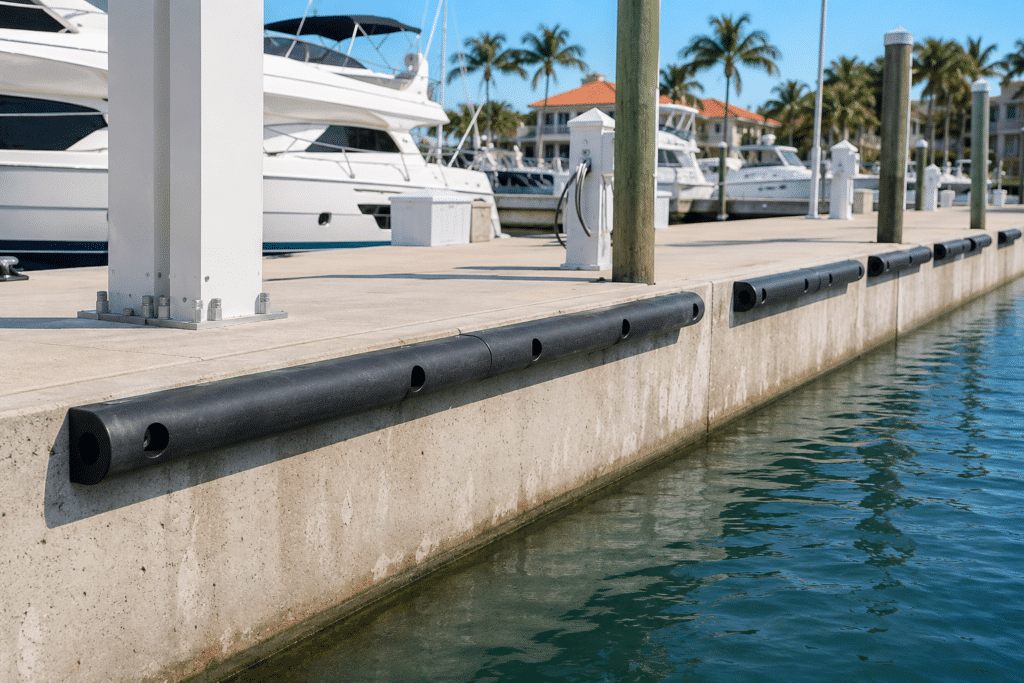
A dock bumper looks like a simple piece of protection, but choosing one is not always as straightforward as matching a profile to the edge of a dock. Two bumpers can look similar and perform very differently once they are exposed to regular vessel contact, changing water conditions, and years of outdoor use.
That matters because the wrong choice may not become obvious until the bumper starts wearing faster than expected, the boat is still reaching an exposed section of the dock, or a supposedly protected area keeps taking damage. By then, you may already be replacing more than just the bumper.
Knowing how the different types and materials are designed to perform can help you avoid that mistake. Keep reading to see what separates the main dock bumper options, where each one makes sense, and what you should evaluate before deciding which one belongs on your dock or marina.
What Does a Dock Bumper Actually Need to Do?
Dock bumpers create a buffer between a vessel and a harder dock, pier, piling, or waterfront surface. Instead of allowing the hull or dock structure to take direct contact, the bumper provides a surface designed to cushion repeated impact and rubbing.
That sounds simple, but docking conditions are rarely identical from one location to another.
A protected private slip may see relatively predictable contact from one vessel. A busy marina can have boats of different sizes approaching throughout the day. Commercial docks, workboat facilities, piers, and quays can experience more frequent or demanding contact.
The bumper also has to remain in the correct position. A durable profile installed below or beside the normal point of contact will still leave the vessel exposed.
Before comparing products, identify the surfaces that actually meet during normal docking and movement. That tells you what type of protection you need and where it needs to go.
Common Types of Dock Bumpers
Dock bumpers come in different profiles because dock edges, pilings, corners, and vessel contact areas do not all require the same shape. Techno Rubber Industries manufactures rubber fenders and bumpers, PVC dock bumpers, piling bumpers, edge and side protection, D-type profiles, and custom marine profiles for different waterfront applications.
Straight Dock Edge Bumpers
Straight bumper profiles protect areas where the side of a boat regularly contacts the face or edge of a dock.
These can be installed along longer sections to create continuous coverage rather than protecting only one isolated point. They are useful when a vessel may shift forward or backward while tied up and contact different parts of the dock.
The width and projection of the profile matter. The bumper needs to extend far enough from the mounting surface to keep the vessel away from the harder structure behind it.
D-Type Dock Bumpers
A D-type fender has a flat mounting side with a rounded outward-facing surface. That shape allows the profile to sit against a dock or other structure while presenting a curved contact surface toward the vessel.
D profiles can be solid or hollow depending on the design and required application. They are commonly used for continuous dock-face and marine protection, with different profile sizes available for different levels of contact.
A D-shaped bumper can be particularly useful where you want a defined projecting cushion along a straight contact area.
Piling Bumpers
Pilings create a different problem from flat dock edges. A boat can rub against or contact the piling as water levels, wind, wake, and mooring position change.
Piling bumpers are designed around these exposed vertical areas rather than treating them like a straight dock face. Techno Rubber Industries includes piling bumpers among its dock and marina product options.
When evaluating piling protection, consider the height range where the vessel may make contact, not just its position when the water is calm.
Corner, Edge, and Side Protection
Corners can become concentrated impact points because they protrude beyond adjacent surfaces. Protecting a long dock edge while leaving an exposed corner can still allow direct hull contact during an angled approach.
Edge guards, side guards, corner protection, and related profiles can cover these vulnerable areas. In some installations, several types of dock bumpers may be needed to create continuous protection rather than relying on a single profile everywhere.
Rubber vs. PVC Dock Bumpers: What Changes With the Material?
Profile determines where and how the bumper makes contact. Material influences how the product behaves while exposed to water, sunlight, weather, movement, and repeated contact.
Techno Rubber Industries manufactures both rubber and PVC dock products, so the better material should be determined by the actual application rather than assuming one solution fits every dock.
EPDM Rubber Dock Bumpers
EPDM is well suited to outdoor applications because of its resistance to ozone, UV exposure, water, and weathering. Those characteristics make it useful for permanent marine installations where the profile remains outdoors for extended periods. Techno Rubber uses EPDM across its marine bumper and fender product range.
Rubber also provides elastic deformation under contact, which allows a properly selected fender profile to cushion impact rather than transferring all of that contact directly into the dock or vessel. Rubber formulation, profile geometry, and hardness all influence how the product performs.
EPDM is worth considering for docks, marinas, piers, vessels, and waterfront facilities that regularly experience outdoor exposure and repeated marine contact.
PVC Dock Bumpers
PVC profiles can provide another practical option for dock edges, slips, and other marine areas where the expected contact and installation requirements suit the material.
Techno Rubber manufactures PVC dock bumpers in multiple profile configurations, including shaped bumper products for different mounting and contact areas.
PVC can be particularly useful where a lighter-duty profile provides sufficient protection. Techno Rubber’s existing dock-fender guidance notes its use on residential aluminum and floating dock systems, while EPDM is positioned for more demanding permanent outdoor applications.
The choice should still be based on the specific dock rather than price alone. Exposure, vessel size, contact frequency, mounting method, and the amount of cushioning required can all change the decision.
How to Choose the Right Dock Bumpers for Your Application
The right bumper is the one that protects the real contact points under the conditions your dock actually experiences. That means looking beyond the product name and working through the application before selecting a profile.
Start With the Vessel
Consider the vessels that will normally use the dock.
A dock serving small recreational boats does not experience the same contact as one regularly used by larger workboats or commercial vessels. Vessel size, weight, hull shape, and normal approach all affect where contact occurs and how demanding that contact can become.
If several types of boats use the same location, design protection around the range of likely contact points rather than one ideal vessel position.
Identify the Actual Contact Areas
Watch where boats meet the dock during both arrival and while tied up.
Common areas include:
- Straight dock faces
- Outer edges
- Corners
- Vertical pilings
- Slip sides
- Piers and quays
- Areas where vessels move with wind or wake
A combination of bumper profiles may provide better coverage than trying to make one shape solve every contact problem.
Consider How Often Contact Happens
Frequency changes the demands placed on the bumper.
Occasional contact at a lightly used dock differs from repeated rubbing at a marina or commercial facility. More frequent contact may justify a more substantial rubber profile or a design intended for heavier marine use.
Do not base the decision only on the hardest impact you expect. Repeated lower-level rubbing and compression can also contribute to wear over time.
Check the Mounting Surface
A bumper must work with the structure it is being attached to.
Look at the available mounting area, dimensions, orientation, fastener locations, corners, gaps, and other physical restrictions. Existing holes or an older bumper profile may also affect a replacement project.
If you are replacing a worn component, keep the old bumper or document its cross-section and dimensions before removing it. A sample can be useful when identifying or reproducing the profile.
Match the Material to the Environment
Sunlight, water, temperature, weather, and potential chemical exposure should all be considered before choosing a material.
EPDM offers strong resistance to outdoor weathering, UV, ozone, and water, but it is not the right rubber for every chemical environment. For example, EPDM generally should not be selected where regular petroleum oil, fuel, or hydrocarbon exposure is expected without first reviewing compound compatibility.
Material selection should therefore account for everything the bumper is likely to encounter, not simply the fact that it is being installed near water.
When a Standard Dock Bumper Is Not the Right Fit
Not every dock has a standard edge, vessel position, or existing bumper profile. Older installations may also use shapes that are difficult to identify from a catalog.
That does not necessarily mean the entire protection system has to be redesigned.
For custom or replacement applications, useful information can include:
- An existing bumper sample
- A cross-section drawing
- Profile dimensions
- Photographs of the mounting area
- Material requirements
- Required length or estimated quantity
- The type of vessel or equipment making contact
- Details about weather and operating conditions
Techno Rubber Industries manufactures custom rubber and PVC marine profiles and can work from samples, drawings, measurements, profile numbers, or application requirements.
That can be useful when an existing bumper needs to be matched or when a standard profile does not properly protect the available contact area.
Choose Dock Protection Around the Contact, Not Just the Catalog
The best dock bumpers are not necessarily the biggest, hardest, or most expensive products available. They are the ones correctly matched to the vessel, contact point, mounting surface, environment, and level of use.
Start by looking at what is actually happening at the dock. Identify where boats touch, how they move after tying up, which surfaces remain exposed, and how often the bumper will be put to work. Then choose the profile and material around those conditions.
Techno Rubber Industries manufactures EPDM rubber dock bumpers, PVC dock bumpers, piling protection, marine fender profiles, and custom rubber and plastic extrusions in Medley, Florida. If you have an existing bumper, drawing, measurements, or an application that needs a custom profile, contact the team to review the requirements and determine an appropriate option.
Frequently Asked Questions About Dock Bumpers
Choosing a bumper often raises questions that go beyond profile shape. These answers cover several practical issues to consider before ordering or replacing dock protection.
What are dock bumpers used for?
Dock bumpers help cushion contact between vessels and docks, piers, pilings, quays, and other hard waterfront surfaces. They can reduce direct rubbing, scraping, and impact in areas where vessel contact is expected.
What is the best material for dock bumpers?
There is no single best material for every dock. EPDM rubber is useful for demanding outdoor applications because of its resistance to weather, UV, ozone, and water. PVC may be suitable for lighter-duty dock-edge applications. Vessel size, exposure, contact frequency, and mounting requirements should guide the choice.
Are rubber dock bumpers better than PVC?
Not automatically. Rubber generally provides greater elastic cushioning and EPDM performs well under prolonged outdoor exposure. PVC can still be an appropriate and economical solution for certain lighter-duty installations. The better option depends on the application.
What is a D-type dock bumper?
A D-type bumper has a D-shaped cross-section, usually with a flat mounting face and rounded contact surface. D fenders are used along dock faces and other areas that need continuous cushioning. They may be produced in solid or hollow configurations.
How do I know what size dock bumper I need?
Start with the available mounting area, the projection needed to keep the vessel away from the structure, vessel size, expected contact, and the dimensions of any existing profile. Bigger does not automatically mean better because the bumper still needs to fit and function correctly at the contact point.
Can dock bumpers be installed on pilings?
Yes. Piling bumpers and related profiles are specifically available for protecting vertical piling contact areas. Make sure the protected section covers the range where the vessel can make contact as water level and vessel position change.
How often should dock bumpers be replaced?
There is no universal replacement interval. Inspect them for cracking, permanent deformation, missing sections, loose mounting, severe abrasion, hardening, or damage that leaves the dock structure exposed. Usage and environmental conditions can significantly affect service life.
Can an old dock bumper profile be reproduced?
In many cases, a manufacturer can evaluate an existing sample or drawing to determine whether the profile can be matched or recreated. Techno Rubber Industries accepts samples, measurements, drawings, profile numbers, and application details for custom marine profile projects.
Do I need the same bumper around the entire dock?
Not necessarily. Straight edges, corners, pilings, slips, and higher-contact areas can require different types of protection. Using multiple profiles can provide better coverage when contact conditions vary around the structure.
Where are rubber dock bumpers used besides recreational docks?
Rubber bumpers and marine fenders can be used at marinas, piers, quays, waterfront facilities, commercial vessels, workboats, and other locations where surfaces face repeated impact or rubbing.