
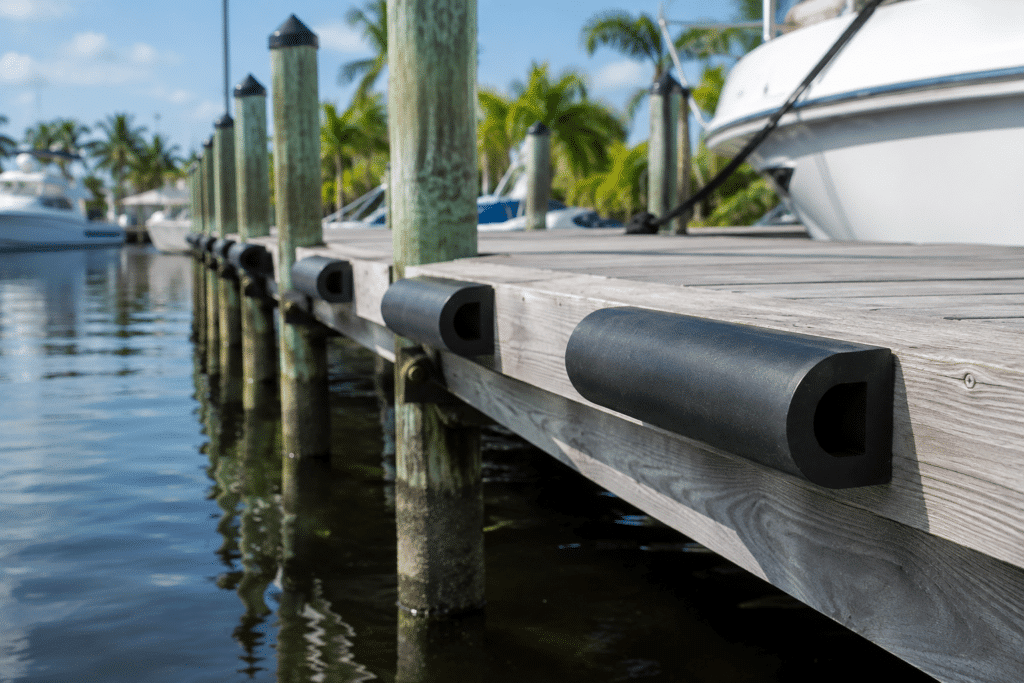
At first glance, choosing between PVC and rubber dock bumpers seems like a simple material decision. But once you factor in vessel traffic, repeated impact, weather exposure, maintenance, and the type of dock you are protecting, that choice becomes much more important.
A bumper can look durable and still be wrong for the way your marina is actually used. That can mean faster wear, more frequent replacement, or protection that does not hold up where you need it most.
So which material actually makes more sense for your marina? The answer depends on more than price or appearance. This comparison breaks down the real differences between PVC and rubber dock bumpers so you can make a better choice before installing or replacing them.
What Is the Main Difference Between PVC and Rubber Dock Bumpers?
Both materials can protect docks and vessels from direct contact, but they do not behave the same way under pressure.
Techno Rubber Industries manufactures both high-impact PVC dock bumpers and EPDM rubber marine fenders, allowing the profile and material to be selected around the application rather than forcing one material across an entire marina.
PVC Dock Bumpers
PVC dock bumpers are rigid or semi-flexible extruded profiles installed along dock edges, pilings, sides, and other exposed areas.
Techno Rubber manufactures high-impact PVC products in several shapes, including A-, C-, D-, and P-type bumpers, along with piling bumpers, edge guards, and side guards. Some profiles are available in commercial and industrial grades, and certain P-shaped products are specifically intended for high-traffic areas.
PVC is therefore not limited to decorative or lightly used dock edges. The profile design and grade need to match the application.
EPDM Rubber Dock Bumpers
Rubber dock bumpers use the elasticity of the material to create a more forgiving surface between a vessel and the structure.
Techno Rubber’s marine rubber bumpers and fenders are manufactured from EPDM for applications involving repeated impact, rubbing, outdoor exposure, and ongoing marine use. Its rubber profiles include Series A, Series D, dock bumpers, vessel fenders, and custom extrusions.
For marina areas where cushioning repeated vessel contact is the main priority, that ability to compress and recover can become an important part of the selection.
How Do PVC and Rubber Handle Vessel Contact Differently?
A marina does not experience only one kind of contact. Boats can lightly rub along an edge, press against a piling while tied up, or approach a berth with enough movement that the bumper needs to cushion a more noticeable impact.
The amount and type of contact should influence the material.
Rubber Provides More Elastic Cushioning
EPDM rubber can deform as a vessel pushes against the profile, creating a cushion between two harder surfaces.
Techno Rubber positions its EPDM marine bumpers for docks, piers, commercial vessels, and heavy-use waterfront facilities exposed to repeated impact and rubbing. Its rubber products are intended to help reduce harsh contact, scraping, edge damage, and surface wear.
That makes rubber especially relevant where vessels repeatedly press, berth, or move against the same area.
The profile still matters. A small rubber extrusion does not automatically provide enough protection simply because it is rubber. Dimensions, shape, hardness, and the amount of material available to compress all affect performance.
PVC Creates Durable Fixed Edge Protection
High-impact PVC takes a somewhat different approach.
Rather than being selected primarily for elastic cushioning, PVC profiles can provide durable coverage over dock edges, pilings, and other surfaces where boats may rub or bump.
Techno Rubber’s PVC line includes profiles specifically designed for fixed and floating docks. Its P Shape Dock Bumper 3262, for example, uses layered co-extrusion with UV protection and is offered for commercial and industrial applications, including high-traffic areas.
For portions of a marina where the priority is maintaining a clean protective surface along a dock edge rather than absorbing heavier vessel contact, PVC can be a practical choice.
Which Material Holds Up Better Outdoors?
Marina bumpers spend their lives around water, sunlight, temperature changes, and weather. Material selection therefore needs to account for more than what happens during docking.
Both PVC and EPDM products can be formulated for outdoor applications, but their performance characteristics differ.
EPDM Is Built Around Weather Resistance
EPDM is widely used for exterior seals, bumpers, and marine profiles because it resists ozone, UV exposure, moisture, weathering, and aging.
Techno Rubber’s rubber dock bumper products use EPDM specifically for those outdoor characteristics. Several of its current rubber fender profiles are made from 100% EPDM with UV, ozone, and aging protection.
That combination makes EPDM particularly valuable where a bumper stays outdoors permanently and needs to maintain flexibility while being exposed to marine conditions.
PVC Performance Depends on the Formulation and Profile
PVC should not be treated as one uniform material.
Techno Rubber manufactures its dock products from high-impact PVC, with UV protection incorporated into specific profiles. The company’s C-shaped dock bumper, for example, is designed for fixed and floating docks and is manufactured from UV-protected high-impact PVC.
The important question is therefore not simply, “Is PVC weather-resistant?” It is whether the specific PVC compound and profile were designed for the outdoor conditions and level of use at your marina.
Where Does PVC Make the Most Sense in a Marina?
PVC becomes particularly useful when you need defined, consistent protection along edges and structural contact areas without requiring the greater elastic cushioning of a rubber fender.
Different parts of a marina may make good candidates.
Dock Edges and Finger Piers
Long exposed edges often need continuous coverage to keep hulls from contacting harder dock materials.
Extruded PVC profiles can create that protective surface along a consistent length. Different A-, C-, D-, and P-shaped designs provide options for varying dock geometries.
Pilings
Vertical pilings can create concentrated contact points as vessels shift with wind, wake, current, or water-level changes.
Techno Rubber manufactures dedicated high-impact PVC piling bumpers for these applications, giving marina operators another option besides applying a general dock-edge profile to a vertical structure.
Areas Where Appearance and Edge Coverage Matter
A continuous extruded PVC profile can also provide a cleaner finished appearance along exposed dock edges.
This can matter in recreational marinas, private slips, and customer-facing waterfront areas where protection needs to function without making the installation look improvised.
Where Does Rubber Make More Sense in a Marina?
Rubber becomes more compelling as the need for cushioning and repeated contact increases.
A marina should look closely at the areas where vessels regularly press, rub, berth, or make more substantial contact.
Heavier or More Frequent Vessel Contact
Commercial slips, workboat areas, busy marina sections, piers, and similar locations can experience contact much more frequently than a lightly used private berth.
Techno Rubber’s EPDM fenders are designed for repeated marine contact and are available in multiple profile sizes and shapes.
A larger or differently shaped rubber profile can also provide more material between the vessel and the structure when the application requires greater cushioning.
Areas Where Boats Remain Against the Fender
Some fenders do more than absorb the initial arrival.
A tied vessel may continue pressing and rubbing against the same dock face as conditions change. Rubber can provide a more forgiving contact surface for those repeated movements.
That does not mean every marina edge needs rubber. It means the locations experiencing this type of contact deserve a different evaluation from areas that mainly need edge coverage.
Custom Commercial Applications
Standard profiles are not always enough for older marinas, specialty docks, workboats, or unusual mounting surfaces.
Techno Rubber Industries can manufacture custom rubber bumper and fender profiles around project dimensions, samples, drawings, mounting areas, contact points, and application requirements.
How Should a Marina Choose Between PVC and Rubber?
The best comparison is not material against material in isolation. It is material plus profile against the conditions at each contact point.
Several questions can narrow the decision quickly.
How Hard Is the Expected Contact?
Start with the vessels.
Consider their size, how they approach, how often the berth is used, and what happens once they are tied up.
Light rubbing along an edge may not require the same solution as a workboat repeatedly pressing against a pier.
Where Will the Bumper Be Installed?
Look separately at:
- Straight dock edges
- Corners
- Finger piers
- Pilings
- Fixed docks
- Floating docks
- Commercial berths
- Loading or work areas
One marina can reasonably use PVC in some of these locations and rubber in others.
How Much Projection Is Needed?
A bumper has to extend far enough from the dock to become the contact surface.
Profile depth can matter just as much as material. A product with inadequate projection may still allow another part of the vessel to reach the structure behind it.
What Will the Bumper Be Mounted To?
Timber, aluminum, concrete, steel, and other surfaces create different mounting conditions.
Check the available mounting area, fastener position, existing holes, corners, and structural obstructions before selecting a profile.
Are You Replacing an Existing Bumper?
Do not throw the old profile away before documenting it.
Keep a section if possible and record its:
- Cross-section
- Width and height
- Material
- Length
- Mounting method
- Fastener locations
- Area of wear or failure
That information can help determine whether the same profile should be replaced or whether the previous setup was undersized or poorly matched to the application.
Does Your Marina Have to Choose Only One Material?
No. In many marinas, that would create an unnecessary limitation.
A PVC piling bumper may work well around one part of the facility while a larger EPDM fender makes more sense where heavier vessels repeatedly contact a dock face. Edge guards may protect exposed corners while rubber profiles handle areas that need more cushioning.
Techno Rubber offers both high-impact PVC and EPDM marine products, including dock bumpers, piling protection, edge and side guards, Series A and Series D rubber fenders, and custom profiles.
Using different products where the conditions change can create a better protection system than selecting one material for every dock simply for consistency.
Choose the Bumper Around the Marina, Not the Material Name
The answer to PVC vs. rubber dock bumpers is not that one material wins in every marina.
PVC can provide durable, consistent protection along dock edges, pilings, and other contact areas, with high-impact profiles available for commercial and high-traffic applications. EPDM rubber provides greater elastic cushioning and strong resistance to the outdoor conditions found in demanding marine environments.
The better choice depends on what happens at the specific part of the dock you are trying to protect.
Techno Rubber Industries manufactures PVC dock bumpers, EPDM rubber marine fenders, piling bumpers, edge and side guards, and custom extrusion profiles in the USA. If your marina is replacing existing bumpers or planning protection for a new dock system, send the team your dimensions, drawings, samples, vessel information, and contact requirements so the appropriate profile and material can be reviewed.
Frequently Asked Questions About PVC vs. Rubber Dock Bumpers
Material is only one part of choosing marina protection. These questions address some of the practical differences that can affect the final decision.
Are rubber dock bumpers better than PVC?
Not in every application. EPDM rubber is particularly useful when greater cushioning, repeated impact resistance, and long-term outdoor exposure are priorities. High-impact PVC can be a strong option for dock edges, pilings, side guards, and other applications where durable fixed coverage is needed.
Which is better for a high-traffic marina?
The answer depends on the type of traffic. Heavy or repeated vessel contact may make an appropriately sized EPDM rubber fender more suitable. High-traffic does not automatically exclude PVC, however. Techno Rubber offers commercial and industrial high-impact PVC profiles specifically identified for high-traffic areas.
Is EPDM rubber waterproof?
EPDM is highly resistant to water and moisture and is widely used in outdoor sealing and marine applications. Techno Rubber uses EPDM for marine products that also require resistance to UV, ozone, weather, and aging.
Are PVC dock bumpers UV-resistant?
They can be when formulated for outdoor use. Techno Rubber’s dock bumper range includes UV-protected high-impact PVC profiles intended for marine environments.
Can PVC dock bumpers be used on floating docks?
Yes. Several Techno Rubber PVC profiles are intended for fixed or floating dock applications. The appropriate shape and size still depend on the dock design and vessel contact area.
Which material is better for dock pilings?
Both may be options depending on the required protection. Techno Rubber manufactures dedicated high-impact PVC piling bumpers as well as rubber marine profiles. Consider the piling shape, vessel movement, required cushioning, mounting surface, and contact frequency before deciding.
How long do dock bumpers last?
There is no universal service life. Exposure, vessel traffic, material, profile design, mounting, and maintenance all affect longevity. Techno Rubber lists some individual 100% EPDM profiles as offering up to 10 years without major changes or aging, but that product-specific statement should not be treated as a warranty or universal lifespan for every installation.
How do I know when a marina bumper needs replacement?
Look for cracking, severe abrasion, permanent deformation, loose fasteners, missing sections, splitting, or wear that allows vessels to contact the underlying dock structure. Problems with placement or profile size should also be corrected rather than simply replacing the old bumper with an identical one.
Can PVC and rubber dock bumpers be used in the same marina?
Yes. Different contact areas can benefit from different materials and profiles. A marina can use PVC edge or piling protection in one location and rubber fenders where greater cushioning is needed.
Can Techno Rubber match an existing dock bumper profile?
Techno Rubber Industries can review samples, drawings, dimensions, mounting requirements, and other application details for replacement or custom extrusion needs. Whether an exact match is possible depends on the profile and project requirements.